Page 2 of 2
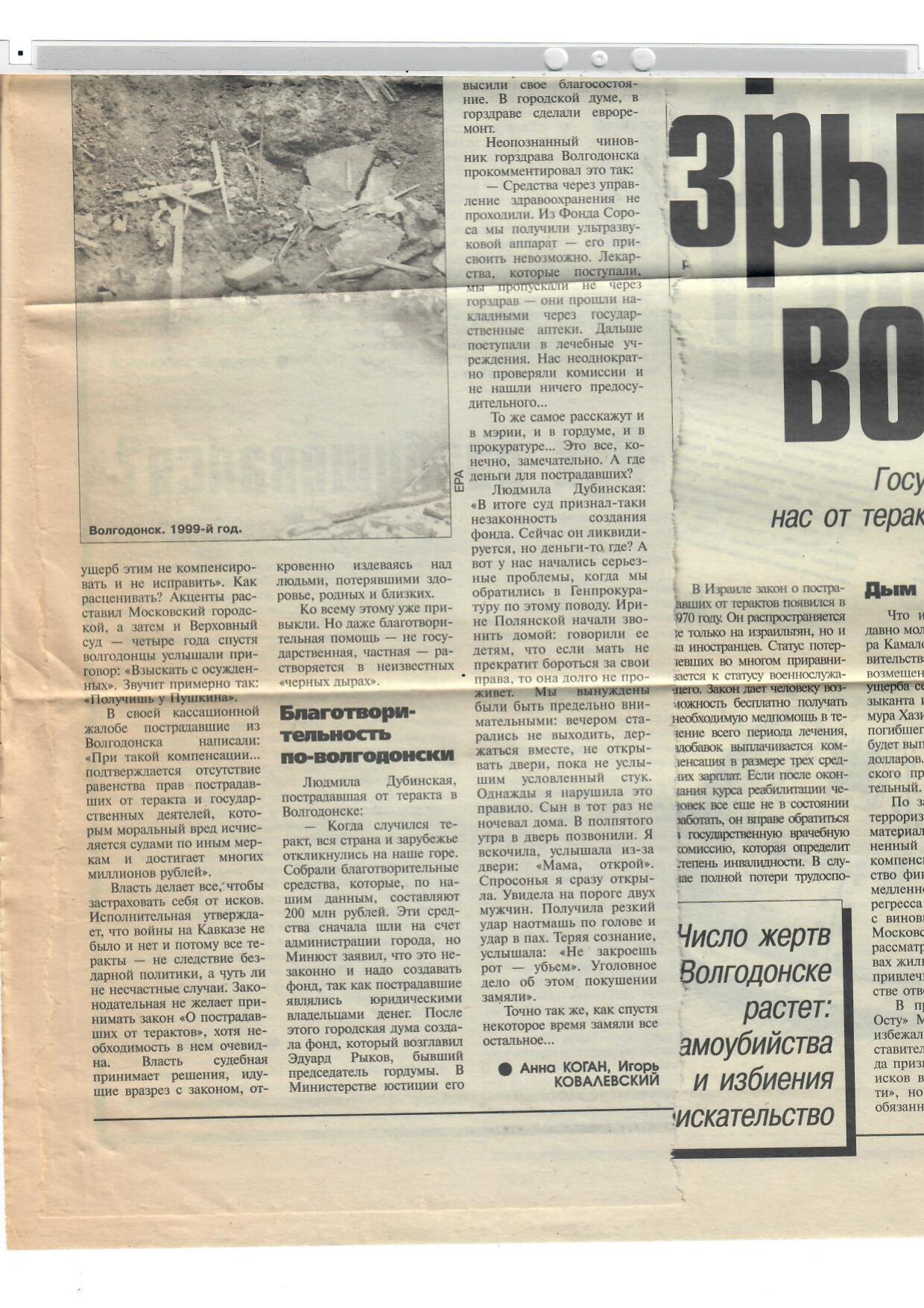
ВЗРЫВ ВО... 1999-й год. Госу... нас от терак... Волгодонск. 1999-й год. ущерб этим не компенсировать и не исправить». Как расценивать? Акценты расставил Московский городской, а затем и Верховный суд — четыре года спустя волгодонцы услышали приговор: «Взыскать с осужденных». Звучит примерно так: «Получишь у Пушкина». В своей кассационной жалобе пострадавшие из Волгодонска написали: «При такой компенсации... подтверждается отсутствие равенства прав пострадавших от теракта и государственных деятелей, которым моральный вред исчисляется судами по иным меркам и достигает многих миллионов рублей». Власть делает все, чтобы застраховать себя от исков. Исполнительная утверждает, что войны на Кавказе не было и нет и потому все теракты — не следствие бездарной политики, а чуть ли не несчастные случаи. Законодательная не желает принимать закон «О пострадавших от терактов», хотя необходимость в нем очевидна. Власть судебная принимает решения, идущие вразрез с законом, откровенно издеваясь над людьми, потерявшими здоровье, родных и близких. Ко всему этому уже привыкли. Но даже благотворительная помощь — не государственная, частная — растворяется в неизвестных «черных дырах». Благотворительность по-волгодонски Людмила Дубинская, пострадавшая от теракта в Волгодонске: — Когда случился теракт, вся страна и зарубежье откликнулись на наше горе. Собрали благотворительные средства, которые, по нашим данным, составляют 200 млн рублей. Эти средства сначала шли на счет администрации города, но Минюст заявил, что это незаконно и надо создавать фонд, так как пострадавшие являлись юридическими владельцами денег. После этого городская дума создала фонд, который возглавил Эдуард Рыков, бывший председатель гордумы. В Министерстве юстиции его высили свое благосостояние. В городской думе, в горздраве сделали евроремонт. Неопознанный чиновник горздрава Волгодонска прокомментировал это так: — Средства через управление здравоохранения не проходили. Из Фонда Сороса мы получили ультразвуковой аппарат — его присвоить невозможно. Лекарства, которые поступали, мы пропускали не через горздрав — они прошли накладными через государственные аптеки. Дальше поступали в лечебные учреждения. Нас неоднократно проверяли комиссии и не нашли ничего предосудительного... То же самое расскажут и в мэрии, и в гордуме, и в прокуратуре... Это все, конечно, замечательно. А где деньги для пострадавших? Людмила Дубинская: «В итоге суд признал-таки незаконность создания фонда. Сейчас он ликвидируется, но деньги-то, где? А вот у нас начались серьезные проблемы, когда мы обратились в Генпрокуратуру по этому поводу. Ирине Полянской начали звонить домой: говорили ее детям, что если мать не прекратит бороться за свои права, то она долго не проживет. Мы вынуждены были быть предельно внимательными: вечером старались не выходить, держаться вместе, не открывать двери, пока не услышим условленный стук. Однажды я нарушила это правило. Сын в тот раз не ночевал дома. В полпятого утра в дверь звонили. Я вскочила, услышала из-за двери: «Мама, открой». Спросонья я сразу открыла. Увидела на пороге двух мужчин. Получила резкий удар наотмашь по голове и удар в пах. Теряя сознание, услышала: «Не закроешь рот — убьем». Уголовное дело об этом покушении замяли». Точно так же, как спустя некоторое время замяли все остальное... Анна КОГАН, Игорь КОВАЛЕВСКИЙ В Израиле закон о пострадавших от терактов появился в 1970 году. Он распространяется не только на израильтян, но и на иностранцев. Статус потерпевших во многом приравнивается к статусу военнослужащего. Закон дает человеку возможность бесплатно получать необходимую медпомощь в течение всего периода лечения, вдобавок выплачивается компенсация в размере трех средних зарплат. Если после окончания курса реабилитации человек все еще не в состоянии работать, он вправе обратиться в государственную врачебную комиссию, которая определит степень инвалидности. В случае полной потери трудоспо... Число жертв в Волгодонске растет: самоубийства и избиения искательство
Explosion in... 1999. State... us from terror... Volgodonsk. 1999.
"...damage cannot be compensated or fixed by this." How to evaluate it? The accents were set by the Moscow City Court, and then by the Supreme Court — four years later, the people of Volgodonsk heard the verdict: "Recover from the convicted." It sounds something like: "You'll get it from Pushkin" [a Russian idiom meaning "you'll get nothing"].
In their cassation appeal, the victims from Volgodonsk wrote: "With such compensation... the lack of equality between the rights of victims of a terrorist attack and government officials, for whom moral damage is calculated by courts using different standards and reaches many millions of rubles, is confirmed."
The authorities are doing everything to insure themselves against lawsuits. The executive branch claims that there was and is no war in the Caucasus, and therefore all terrorist attacks are not a consequence of incompetent policy, but almost accidents. The legislature does not want to pass a law "On Victims of Terrorist Attacks," although the need for it is obvious. The judicial branch makes decisions that run counter to the law, openly mocking people who have lost their health, relatives, and loved ones. Everyone has already gotten used to all this.
But even charitable aid — not state, but private — dissolves in unknown "black holes."
Charity Volgodonsk-style
Lyudmila Dubinskaya, a victim of the terrorist attack in Volgodonsk:
- When the terrorist attack happened, the whole country and foreign countries responded to our grief. Charitable funds were collected, which, according to our data, amount to 200 million rubles.
- These funds first went to the city administration's account, but the Ministry of Justice stated that this was illegal and a fund had to be created, as the victims were the legal owners of the money.
- After that, the city duma created a fund headed by Eduard Rykov, the former chairman of the city duma.
- In the Ministry of Justice, his... [text missing] ...increased their well-being.
- In the city duma, in the city health department, they did European-style renovations.
An unidentified official of the Volgodonsk city health department commented on it this way:
- Funds did not pass through the health department. We received an ultrasound machine from the Soros Foundation — it's impossible to misappropriate it.
- The medicines that arrived, we didn't pass through the city health department — they went through invoices through state pharmacies. Then they went to medical institutions.
- We were repeatedly checked by commissions and they found nothing reprehensible...
- They will tell you the same thing in the mayor's office, and in the city duma, and in the prosecutor's office... This is all, of course, wonderful. But where is the money for the victims?
Lyudmila Dubinskaya: "In the end, the court did recognize the illegality of creating the fund. Now it is being liquidated, but where is the money? And we started having serious problems when we turned to the Prosecutor General's Office about this. They started calling Irina Polyanskaya at home: they told her children that if their mother didn't stop fighting for her rights, she wouldn't live long. We had to be extremely careful: we tried not to go out in the evening, to stick together, not to open doors until we heard a pre-arranged knock. Once I broke this rule. My son didn't stay home that night. At half past four in the morning, the doorbell rang. I jumped up, heard from behind the door: "Mom, open up." Half-asleep, I opened it immediately. I saw two men on the doorstep. I received a sharp blow to the head and a blow to the groin. Losing consciousness, I heard: "If you don't shut your mouth, we'll kill you." The criminal case about this assassination attempt was hushed up." Just as, after some time, everything else was hushed up...
Anna KOGAN, Igor KOVALEVSKY
Israel's Law on Victims of Terrorist Attacks
In Israel, a law on victims of terrorist attacks appeared in 1970. It applies not only to Israelis but also to foreigners. The status of victims is largely equated to the status of military personnel. The law gives a person the opportunity to receive necessary medical care free of charge throughout the entire period of treatment; in addition, compensation in the amount of three average salaries is paid.
If, after completing the rehabilitation course, a person is still unable to work, they have the right to apply to a state medical commission, which will determine the degree of disability. In case of total loss of work capacity...
The number of victims in Volgodonsk is growing: suicides and beatings [fragment]