снятых Гочияевым помещений произошли взрывы, он окончательно понял, что его подставили. «Я сразу позвонил в милицию, в «скорую», даже в службу спасения 911 и сообщил о складах на Борисовских Прудах и в Капотне, где после этого взрывы удалось предотвратить. <...> Сейчас я почти уверен, что этот человек, с которым я работал (все данные на него я предоставлю позже), является агентом ФСБ».
Просил ли агент снимать помещения по чужому паспорту, в письме не говорится.
Во вторых показаниях Гочияева — в стенограмме видеоинтервью — этого человека обозначили инициалом К. Основываясь на первых показаниях (письме), где Гочияев назвал свою фирму — «Капстрой-2000», мы предположили, что под К. он имеет в виду соучредителя этой фирмы Кармишина. Позже бывший следователь ФСБ, а ныне адвокат Михаил Трепашкин поделился с нами информацией, которую он представил также группам Ковалева и Фельштинского: другая фирма — «Бранд-2» — была учреждена за два месяца до событий, 13.7.1999. О Лайпанове писали как о ее сотруднике, снимавшем помещения по разным адресам. А ее руководителем числится Алексей Андреевич Колобанов.
Сейчас мы склоняемся к мнению, что именно его имеет в виду Гочияев — независимо от того, правду или нет он говорит и пишет.
Юридический адрес фирмы — Люсиновская ул., 41. По этому адресу мы ее не нашли (далее станет ясно, что это обычный случай). А телефон руководителя, указанный в регистрационных данных, принадлежит учреждению, находящемуся совсем в другом месте, — Московскому управлению Министерства по налогам и сборам.
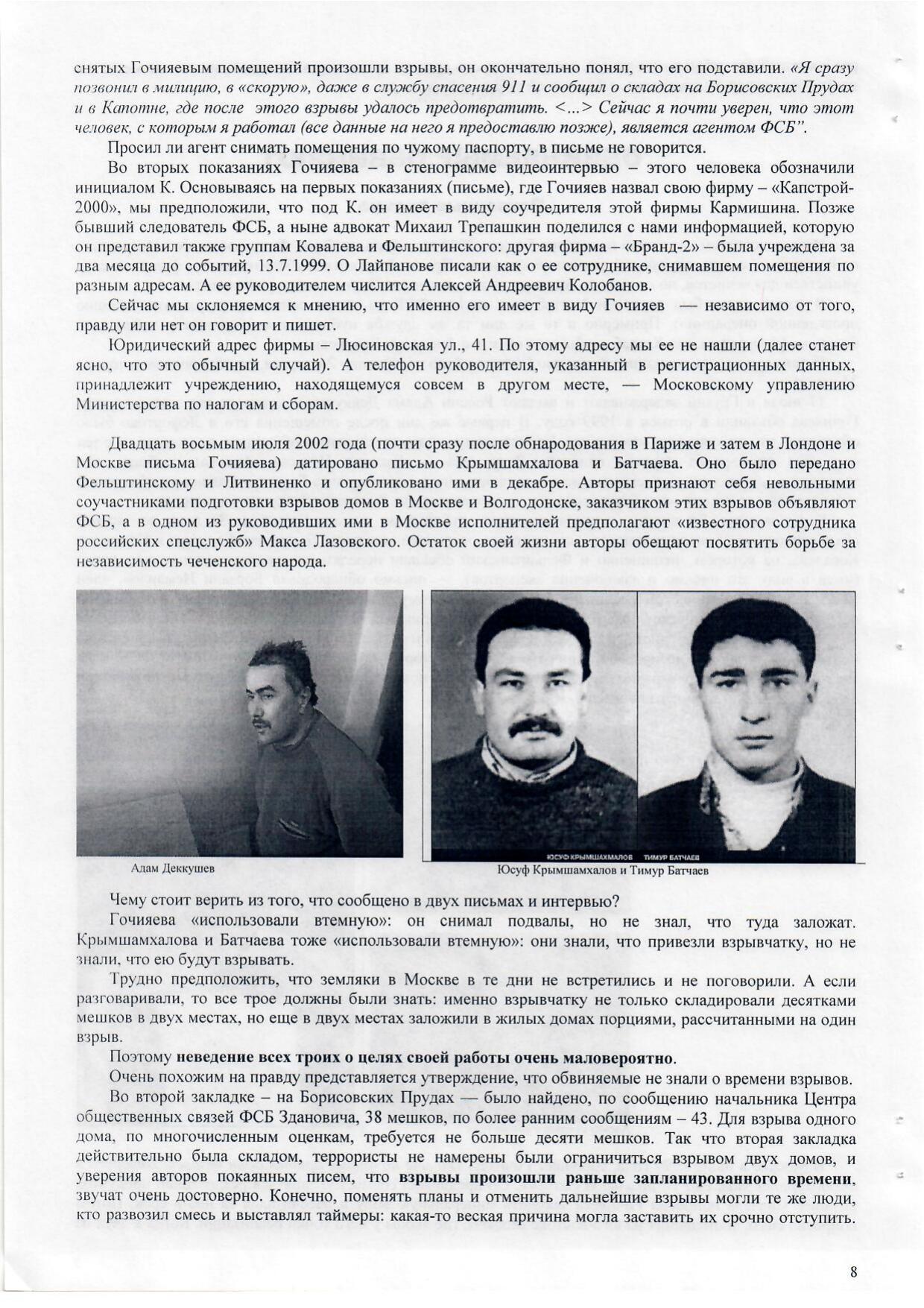
Двадцать восьмым июля 2002 года (почти сразу после обнародования в Париже и затем в Лондоне и Москве письма Гочияева) датировано письмо Крымшамхалова и Батчаева. Оно было передано Фельштинскому и Литвиненко и опубликовано ими в декабре. Авторы признают себя невольными соучастниками подготовки взрывов домов в Москве и Волгодонске, заказчиком этих взрывов объявляют ФСБ, а в одном из руководивших ими в Москве исполнителей предполагают «известного сотрудника российских спецслужб» Макса Лазовского. Остаток своей жизни авторы обещают посвятить борьбе за независимость чеченского народа.
[Фото: Адам Деккушев]
[Фото: Юсуф Крымшамхалов и Тимур Батчаев]
Чему стоит верить из того, что сообщено в двух письмах и интервью?
Гочияева «использовали втемную»: он снимал подвалы, но не знал, что туда заложат. Крымшамхалова и Батчаева тоже «использовали втемную»: они знали, что привезли взрывчатку, но не знали, что ею будут взрывать.
Трудно предположить, что земляки в Москве в те дни не встретились и не поговорили. А если разговаривали, то все трое должны были знать: именно взрывчатку не только складировали десятками мешков в двух местах, но еще в двух местах заложили в жилых домах порциями, рассчитанными на один взрыв.
Поэтому неведение всех троих о целях своей работы очень маловероятно.
Очень похожим на правду представляется утверждение, что обвиняемые не знали о времени взрывов.
Во второй закладке — на Борисовских Прудах — было найдено, по сообщению начальника Центра общественных связей ФСБ Здановича, 38 мешков, по более ранним сообщениям — 43. Для взрыва одного дома, по многочисленным оценкам, требуется не больше десяти мешков. Так что вторая закладка действительно была складом, террористы не намерены были ограничиться взрывом двух домов, и уверения авторов покаянных писем, что взрывы произошли раньше запланированного времени, звучат очень достоверно. Конечно, поменять планы и отменить дальнейшие взрывы могли те же люди, кто развозил смесь и выставлял таймеры: какая-то веская причина могла заставить их срочно отступить.
Explosions and Allegations
- Explosions occurred in the premises rented by Gochiyayev; he finally realized he had been set up.
- "I immediately called the police, the 'ambulance', even the 911 emergency service and reported the warehouses on Borisovskie Prudy and in Kapotnya, where explosions were subsequently prevented. <...> Now I am almost certain that this person I worked with (I will provide all data on him later) is an FSB agent."
Details of the Alleged Agent
- Whether the agent asked to rent the premises using someone else's passport is not mentioned in the letter.
- In Gochiyayev's second testimony—in the transcript of a video interview—this person was identified by the initial K.
- Based on the first testimony (the letter), where Gochiyayev named his firm—"Kapstroy-2000", we assumed that by K. he meant the co-founder of this firm, Karmishin.
- Later, a former FSB investigator and now lawyer Mikhail Trepashkin shared information with us, which he also presented to the Kovalev and Felshtinsky groups: another firm—"Brand-2"—was established two months before the events, on July 13, 1999.
- Laipanov was written about as its employee who rented premises at various addresses.
- Its head is listed as Alexey Andreevich Kolobanov.
- Now we are inclined to believe that it is him Gochiyayev means—regardless of whether he is telling and writing the truth or not.
- The legal address of the firm is Lyusinovskaya St., 41. We did not find it at this address (it will later become clear that this is a common occurrence).
- The manager's phone number, indicated in the registration data, belongs to an institution located in a completely different place—the Moscow Department of the Ministry of Taxes and Levies.
Letter from Krymshamkhalov and Batchaev
- A letter from Krymshamkhalov and Batchaev is dated July 28, 2002 (almost immediately after Gochiyayev's letter was made public in Paris and then in London and Moscow).
- It was handed over to Felshtinsky and Litvinenko and published by them in December.
- The authors admit to being involuntary accomplices in the preparation of the apartment bombings in Moscow and Volgodonsk, declare the FSB as the customer of these bombings, and suggest that one of the executors who led them in Moscow was the "well-known employee of the Russian special services" Max Lazovsky.
- The authors promise to dedicate the rest of their lives to the struggle for the independence of the Chechen people.
[Photo: Adam Dekkushev]
[Photo: Yusuf Krymshamkhalov and Timur Batchaev]
Analysis of the Evidence
What should be believed from what was reported in the two letters and the interview?
- Gochiyayev was "used blindly": he rented basements but did not know what would be placed there.
- Krymshamkhalov and Batchaev were also "used blindly": they knew they brought explosives, but did not know they would be used for bombings.
- It is hard to assume that the fellow countrymen in Moscow did not meet and talk in those days.
- And if they talked, then all three must have known: it was specifically explosives that were not only stored in dozens of bags in two places, but also placed in residential buildings in portions calculated for one explosion in two other places.
- Therefore, the ignorance of all three about the goals of their work is very unlikely.
- The claim that the accused did not know the time of the explosions seems very much like the truth.
- In the second cache—on Borisovskie Prudy—38 bags were found, according to the head of the FSB Public Relations Center Zdanovich, and 43 according to earlier reports.
- For the explosion of one house, according to numerous estimates, no more than ten bags are required.
- So the second cache was indeed a warehouse, the terrorists did not intend to limit themselves to the explosion of two houses, and the assurances of the authors of the penitent letters that the explosions occurred earlier than the planned time sound very credible.
- Of course, the same people who delivered the mixture and set the timers could have changed plans and canceled further explosions: some weighty reason could have forced them to retreat urgently.