Page 22 of 22
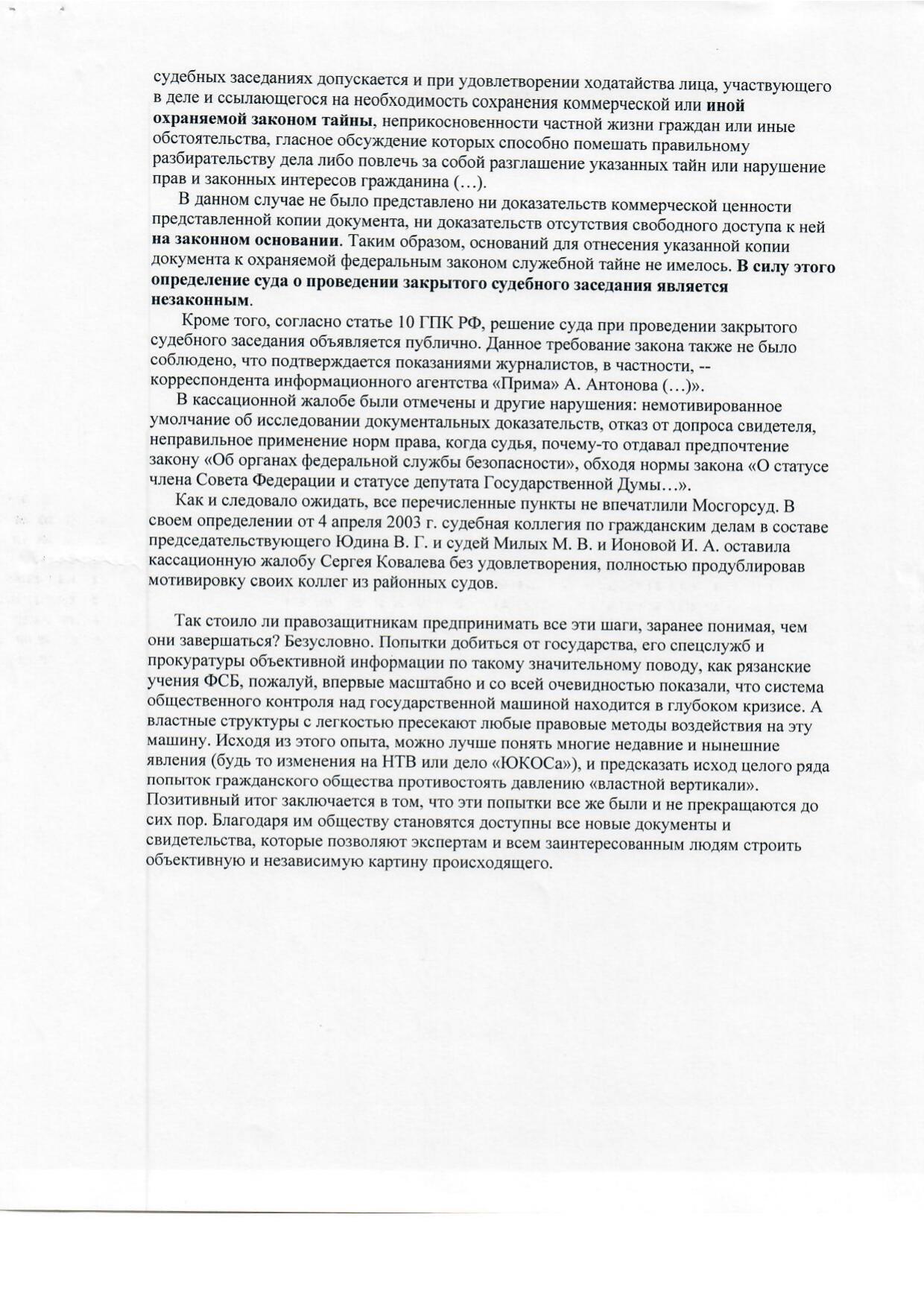
судебных заседаниях допускается и при удовлетворении ходатайства лица, участвующего в деле и ссылающегося на необходимость сохранения коммерческой или иной охраняемой законом тайны, неприкосновенности частной жизни граждан или иные обстоятельства, гласное обсуждение которых способно помешать правильному разбирательству дела либо повлечь за собой разглашение указанных тайн или нарушение прав и законных интересов гражданина (...).
В данном случае не было представлено ни доказательств коммерческой ценности представленной копии документа, ни доказательств отсутствия свободного доступа к ней на законном основании. Таким образом, оснований для отнесения указанной копии документа к охраняемой федеральным законом служебной тайне не имелось. В силу этого определение суда о проведении закрытого судебного заседания является незаконным.
Кроме того, согласно статье 10 ГПК РФ, решение суда при проведении закрытого судебного заседания объявляется публично. Данное требование закона также не было соблюдено, что подтверждается показаниями журналистов, в частности, -- корреспондента информационного агентства «Прима» А. Антонова (...).
В кассационной жалобе были отмечены и другие нарушения: немотивированное умолчание об исследовании документальных доказательств, отказ от допроса свидетеля, неправильное применение норм права, когда судья, почему-то отдавал предпочтение закону «Об органах федеральной службы безопасности», обходя нормы закона «О статусе члена Совета Федерации и статусе депутата Государственной Думы...».
Как и следовало ожидать, все перечисленные пункты не впечатлили Мосгорсуд. В своем определении от 4 апреля 2003 г. судебная коллегия по гражданским делам в составе председательствующего Юдина В. Г. и судей Милых М. В. и Ионовой И. А. оставила кассационную жалобу Сергея Ковалева без удовлетворения, полностью продублировав мотивировку своих коллег из районных судов.
Так стоило ли правозащитникам предпринимать все эти шаги, заранее понимая, чем они завершаться? Безусловно. Попытки добиться от государства, его спецслужб и прокуратуры объективной информации по такому значительному поводу, как рязанские учения ФСБ, пожалуй, впервые масштабно и со всей очевидностью показали, что система общественного контроля над государственной машиной находится в глубоком кризисе. А властные структуры с легкостью пресекают любые правовые методы воздействия на эту машину. Исходя из этого опыта, можно лучше понять многие недавние и нынешние явления (будь то изменения на НТВ или дело «ЮКОСа»), и предсказать исход целого ряда попыток гражданского общества противостоять давлению «властной вертикали». Позитивный итог заключается в том, что эти попытки все же были и не прекращаются до сих пор. Благодаря им обществу становятся доступны все новые документы и свидетельства, которые позволяют экспертам и всем заинтересованным людям строить объективную и независимую картину происходящего.
Legal Analysis and Procedural Violations
Court Hearing Restrictions
Court hearings are permitted only upon the granting of a motion by a participating party that cites one of the following reasons:
* The need to preserve a commercial or other legally protected secret.
* The inviolability of the private life of citizens.
* Other circumstances where public discussion could interfere with the proper trial or lead to the disclosure of secrets or the violation of citizens' rights and legitimate interests.
Findings in the Current Case
- Lack of Evidence for Secrecy: No evidence was presented regarding the commercial value of the submitted document copy, nor was there evidence of a lack of free legal access to it.
- Conclusion on Secrecy: Consequently, there were no grounds to classify the specified document copy as a service secret protected by federal law.
- Illegality of Closed Session: Based on this, the court's ruling to hold a closed court session was deemed illegal.
Violation of Public Announcement Requirements
- Legal Mandate: According to Article 10 of the Code of Civil Procedure of the Russian Federation, the court's decision regarding a closed court session must be announced publicly.
- Failure to Comply: This legal requirement was not met, as confirmed by the testimony of journalists, specifically the correspondent of the "Prima" information agency, A. Antonov.
Additional Violations Noted by Cassation Appeal
The cassation appeal highlighted several other procedural violations:
* Unmotivated silence regarding the examination of documentary evidence.
* Refusal to interrogate a witness.
* Incorrect application of legal norms, where the judge improperly favored the law "On the Bodies of the Federal Security Service," bypassing the norms of the law "On the Status of a Member of the Federation Council and the Status of a Deputy of the State Duma..."
Moscow City Court Ruling
- Decision: The Moscow City Court did not find merit in the listed points.
- Ruling Details: In its ruling dated April 4, 2003, the judicial collegium for civil cases—comprising presiding judge Yudin V. G. and judges Milykh M. V. and Ionova I. A.—rejected the cassation appeal of Sergei Kovalev, duplicating the reasoning of the district courts.
Conclusion on Activism and State Control
- Value of Efforts: The efforts by human rights activists were deemed worthwhile, despite the anticipated negative outcome.
- Systemic Crisis: Attempts to obtain objective information from the state, its special services, and the prosecutor's office regarding the Ryazan FSB exercises revealed that the system of public control over the state apparatus is in a deep crisis.
- Power Dynamics: The findings suggest that power structures easily suppress any legal methods of influencing this system.
- Broader Implications: This experience provides insight into recent and current phenomena (such as the changes at NTV or the "YUKOS" case) and allows for predictions regarding civil society's resistance against the "power vertical."
- Positive Outcome: The positive result is that these attempts have occurred and continue, leading to the availability of new documents and evidence for society, enabling experts and interested parties to build an objective and independent picture of events.