Page 1 of 2
[Рукописные пометки вверху]
921-08-17 (зачеркнуто)
Консул-бизнес в 99г.
Нухаева
Ел. Ник.
ул. Лобач-го д. 100 к. 3 кв. 638
932-44-02 дом.
ООО «Профессионал-Гарант»
202-62-69 раб.
[МК]-хроники,
опубликовал статью «Безбородый имам Гочияев»
923-70-86 р.
я: 264-97-50 д.
[Печатный текст]
Уставной фонд... 7.600
Торгово-закупочная деятельность
Банк развития предпринимательства и культуры, р/с 467012
Дата регистрации: 8.07.96 г.
Регистрационный номер: 860251
Вновь создаваемое
Свидетельство серии БЕ № 1898 от 15.08.96 г.
Код ОКПО: 44485211
Количество учредителей физических лиц: 2
13 инспекция МНС РФ, Северный округ, Тимирязевская
ИНН 7713112158 (значится как не сдавшее налоговый отчет)
Учредители:
1. Гочияев Ачемез Шагабанович
Гор. Москва, ул. Маршала Катукова, дом 6, корпус 2, кв. 188
паспорт XV-ГН № 691912, выдан ОВД администрации гор. Карачаевска Карачаево-Черкесской Республики 16.11.95 г.
взнос: 3.800
доля: 50 %
дата: 14.08.96 г.
- Кармишин Александр Юрьевич
Адрес: Смоленская обл., гор. Вязьма, ул. Л. Шмидта, дом 10, кв. 45
паспорт II-ГУ № 507107, выдан 1 о/м ОВД Ленинского горисполкома Кзыл-Ордынской области 24.03.81 г.
Сумма взноса: 3.800
Процентная доля: 50 %
дата: 14.08.96 г.
Установлены номера телефонов, которыми пользовался Гочияев А.Ш.:
1. Домашний: 499-08-72 (в настоящее время изменилась АТС)
Телефон был записан на бывшую хозяйку квартиры Эдневу Х.А.
2. Мобильный сети «Билайн» 961-94-26
Первое подключение 21.02.96 г.
отключение 24.11.97 г.
зарегистрирован был на Гочияева Ачемеза Шагабовича, проживающего по адресу: г. Карачаевск, ул. Д. Юрченко, дом 25, кв. 8
Второе подключение с 8.04.98 г. по ....
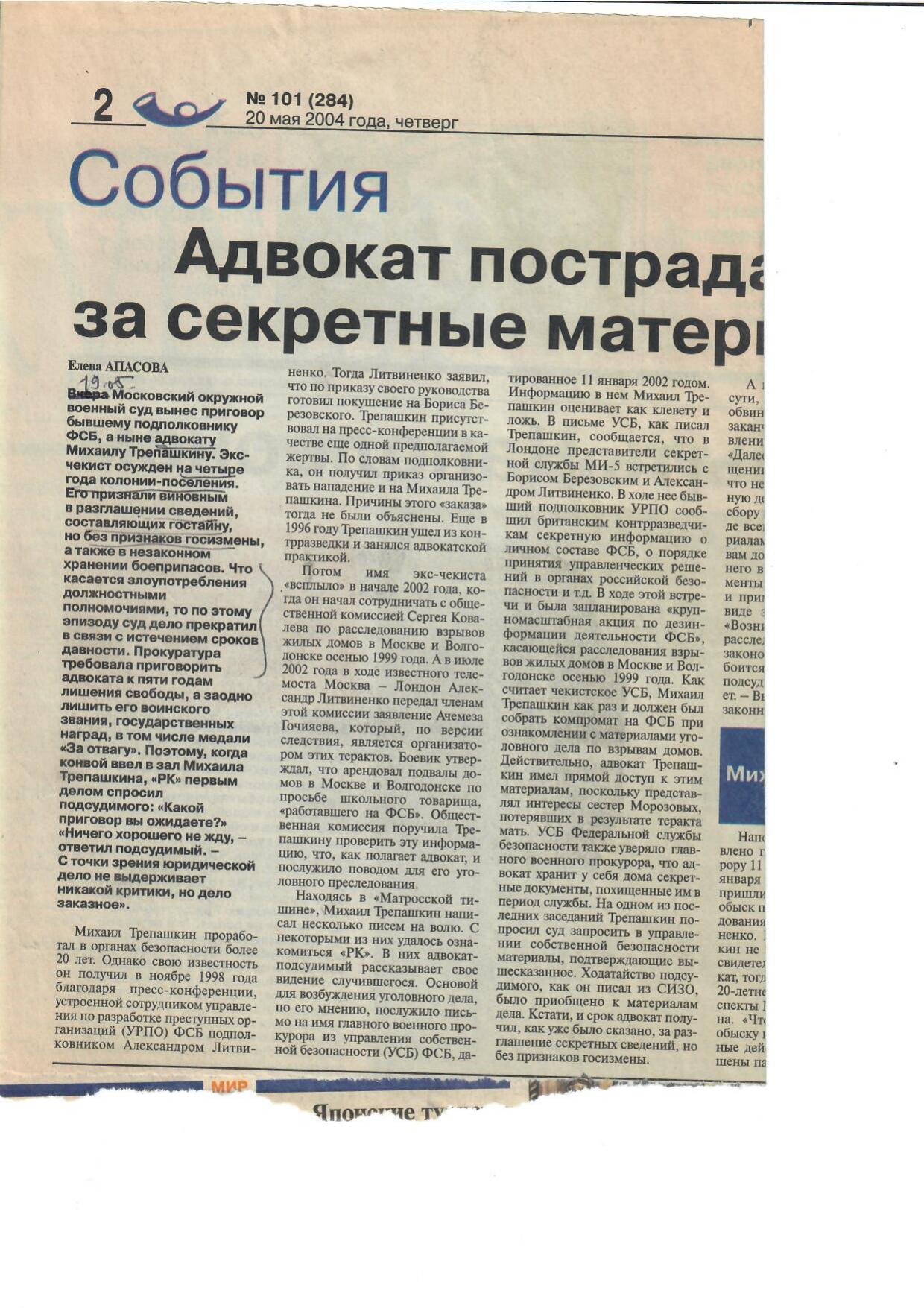
Events
Lawyer suffered for secret materials
Elena APASOVA
19.05.
Yesterday, the Moscow District Military Court delivered a verdict against former FSB Lieutenant Colonel and current lawyer Mikhail Trepashkin. The former Chekist was sentenced to four years in a settlement colony. He was found guilty of disclosing information constituting a state secret, but without signs of high treason, as well as illegal possession of ammunition. Regarding the abuse of official powers, the court dismissed the case on this count due to the expiration of the statute of limitations. The prosecution had requested a five-year prison sentence for the lawyer, along with stripping him of his military rank and state awards, including the "For Courage" medal. Therefore, when the guards brought Mikhail Trepashkin into the courtroom, "RK" first asked the defendant: "What verdict do you expect?" "I expect nothing good," the defendant replied. "From a legal standpoint, the case does not withstand any criticism, but the case is a contract job."
Mikhail Trepashkin worked in the security services for over 20 years. However, he gained fame in November 1998 thanks to a press conference organized by Lieutenant Colonel Alexander Litvinenko, an officer of the FSB's Directorate for the Analysis of Criminal Organizations (URPO). At that time, Litvinenko stated that, on the orders of his superiors, he had prepared an assassination attempt on Boris Berezovsky. Trepashkin attended the press conference as another intended victim. According to the lieutenant colonel, he had received an order to organize an attack on Mikhail Trepashkin as well. The reasons for this "contract" were not explained at the time. Back in 1996, Trepashkin left counterintelligence and took up legal practice.
Later, the former Chekist's name "surfaced" in early 2002 when he began collaborating with Sergei Kovalev's public commission investigating the apartment bombings in Moscow and Volgodonsk in the fall of 1999. In July 2002, during a well-known Moscow-London teleconference, Alexander Litvinenko handed over a statement from Achimez Gochiyayev to the commission members. According to the investigation, Gochiyayev was the organizer of these terrorist attacks. The militant claimed that he had rented the basements of the buildings in Moscow and Volgodonsk at the request of a school friend who "worked for the FSB." The public commission tasked Trepashkin with verifying this information, which, as the lawyer believes, served as the pretext for his criminal prosecution.
While in "Matrosskaya Tishina," Mikhail Trepashkin wrote several letters to the outside world. "RK" managed to review some of them. In them, the defendant-lawyer shares his vision of what happened. The basis for initiating the criminal case, in his opinion, was a letter addressed to the Chief Military Prosecutor from the FSB's Internal Security Directorate (USB), dated January 11, 2002. Mikhail Trepashkin assesses the information in it as slander and lies. In the USB letter, as Trepashkin wrote, it is reported that in London, representatives of the MI5 secret service met with Boris Berezovsky and Alexander Litvinenko. During this meeting, the former URPO lieutenant colonel reportedly provided British counterintelligence with secret information about FSB personnel, the procedure for making management decisions in Russian security agencies, etc. During this meeting, a "large-scale disinformation campaign against FSB activities" was planned, concerning the investigation of the apartment bombings in Moscow and Volgodonsk in the fall of 1999. According to the Chekist USB, Mikhail Trepashkin was precisely the one who was supposed to collect compromising material on the FSB while reviewing the materials of the criminal case on the apartment bombings. Indeed, lawyer Trepashkin had direct access to these materials, as he represented the interests of the Morozov sisters, who lost their mother in the terrorist attack. The FSB's Internal Security Directorate also assured the Chief Military Prosecutor that the lawyer kept secret documents at home, which he had stolen during his service. At one of the recent hearings, Trepashkin asked the court to request materials from the Internal Security Directorate confirming the above. The defendant's motion, as he wrote from the pre-trial detention center (SIZO), was attached to the case materials. Incidentally, the lawyer received his sentence, as already mentioned, for disclosing secret information, but without signs of high treason.