Page 3 of 3
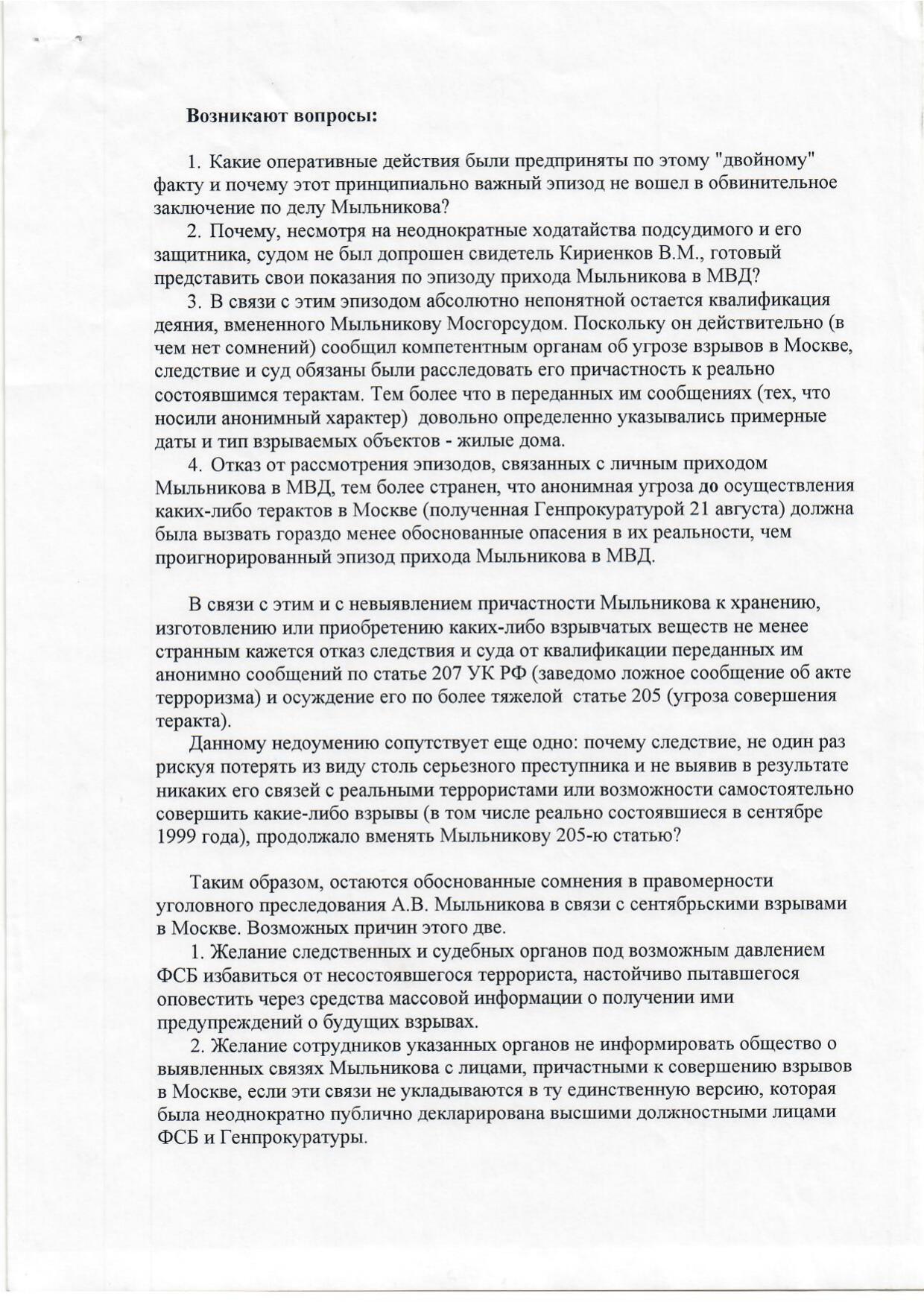
Возникают вопросы:
- Какие оперативные действия были предприняты по этому "двойному" факту и почему этот принципиально важный эпизод не вошел в обвинительное заключение по делу Мыльникова?
- Почему, несмотря на неоднократные ходатайства подсудимого и его защитника, судом не был допрошен свидетель Кириенков В.М., готовый представить свои показания по эпизоду прихода Мыльникова в МВД?
- В связи с этим эпизодом абсолютно непонятной остается квалификация деяния, вмененного Мыльникову Мосгорсудом. Поскольку он действительно (в чем нет сомнений) сообщил компетентным органам об угрозе взрывов в Москве, следствие и суд обязаны были расследовать его причастность к реально состоявшимся терактам. Тем более что в переданных им сообщениях (тех, что носили анонимный характер) довольно определенно указывались примерные даты и тип взрываемых объектов - жилые дома.
- Отказ от рассмотрения эпизодов, связанных с личным приходом Мыльникова в МВД, тем более странен, что анонимная угроза до осуществления каких-либо терактов в Москве (полученная Генпрокуратурой 21 августа) должна была вызвать гораздо менее обоснованные опасения в их реальности, чем проигнорированный эпизод прихода Мыльникова в МВД.
В связи с этим и с невыявлением причастности Мыльникова к хранению, изготовлению или приобретению каких-либо взрывчатых веществ не менее странным кажется отказ следствия и суда от квалификации переданных им анонимно сообщений по статье 207 УК РФ (заведомо ложное сообщение об акте терроризма) и осуждение его по более тяжелой статье 205 (угроза совершения теракта).
Данному недоумению сопутствует еще одно: почему следствие, не один раз рискуя потерять из виду столь серьезного преступника и не выявив в результате никаких его связей с реальными террористами или возможности самостоятельно совершить какие-либо взрывы (в том числе реально состоявшиеся в сентябре 1999 года), продолжало вменять Мыльникову 205-ю статью?
Таким образом, остаются обоснованные сомнения в правомерности уголовного преследования А.В. Мыльникова в связи с сентябрьскими взрывами в Москве. Возможных причин этого две.
1. Желание следственных и судебных органов под возможным давлением ФСБ избавиться от несостоявшегося террориста, настойчиво пытавшегося оповестить через средства массовой информации о получении ими предупреждений о будущих взрывах.
2. Желание сотрудников указанных органов не информировать общество о выявленных связях Мыльникова с лицами, причастными к совершению взрывов в Москве, если эти связи не укладываются в ту единственную версию, которая была неоднократно публично декларирована высшими должностными лицами ФСБ и Генпрокуратуры.
Questions Arise
- What operational actions were taken regarding this "double" fact and why did this fundamentally important episode not enter the indictment in the Mylnikov case?
- Why, despite repeated motions by the defendant and his defense counsel, was the witness V.M. Kirienkov, who was ready to present his testimony regarding the episode of Mylnikov's visit to the MVD, not questioned by the court?
- In connection with this episode, the qualification of the act charged against Mylnikov by the Moscow City Court remains absolutely incomprehensible. Since he indeed (of which there is no doubt) informed the competent authorities about the threat of explosions in Moscow, the investigation and the court were obliged to investigate his involvement in the terrorist attacks that actually took place. Especially since the messages he transmitted (those that were anonymous) quite definitely indicated the approximate dates and the type of objects to be blown up — residential buildings.
- The refusal to consider episodes related to Mylnikov's personal visit to the MVD is all the more strange given that an anonymous threat prior to any terrorist attacks in Moscow (received by the Prosecutor General's Office on August 21) should have caused much less justified fears about their reality than the ignored episode of Mylnikov's visit to the MVD.
In connection with this and with the failure to identify Mylnikov's involvement in the storage, manufacture, or acquisition of any explosive substances, the refusal of the investigation and the court to qualify the messages he transmitted anonymously under Article 207 of the Criminal Code of the Russian Federation (knowingly false report of an act of terrorism) and his conviction under the more severe Article 205 (threat of committing a terrorist act) seems no less strange.
This bewilderment is accompanied by another: why did the investigation, risking more than once losing sight of such a serious criminal and having not identified as a result any of his connections with real terrorists or the possibility of independently carrying out any explosions (including those that actually took place in September 1999), continue to charge Mylnikov under Article 205?
Thus, there remain justified doubts about the legality of the criminal prosecution of A.V. Mylnikov in connection with the September bombings in Moscow. There are two possible reasons for this.
- The desire of the investigative and judicial authorities, under possible pressure from the FSB, to get rid of a failed terrorist who persistently tried to notify the media about their receipt of warnings about future explosions.
- The desire of the employees of the specified bodies not to inform society about the identified connections of Mylnikov with persons involved in the bombings in Moscow, if these connections do not fit into the only version that was repeatedly publicly declared by the highest officials of the FSB and the Prosecutor General's Office.