Денис Сайтаков. Он появлялся вместе с Гочияевым, согласно публикациям, в четырех гостиницах. Непонятно, зачем: у Гочияева, кроме квартиры в Строгине, где он прописан у жены Халимат (по словам соседки, это жена фиктивная), в Москве много лет жила родная сестра — жила одна в ветхом малонаселенном доме в скрытом от глаз месте. Жила в Москве также его любовница Татьяна. Следователь сказал Михаилу Трепашкину, что Гочияев жил на Шоссейной улице — это самый центр рассматриваемых событий. Зачем же двум товарищам было демонстрировать себя по гостиницам? Очень странно и само участие Дениса в мероприятиях: зачем нескольким карачаевцам, которые могли бы обсуждать все дела на своем экзотическом для Москвы языке, привлекать к себе русскоязычного?.. Итак, Денис приехал из Набережных Челнов, но вырос в узбекском городке Карши.
Что перед нами: узбекский след, выражаясь словами Литвиненко (так называется одна из глав его книги)? Литвиненко имеет в виду другое — происхождение своего бывшего начальника, генерала ФСБ Евгения Хохолькова, о котором и он, и другие авторы не раз писали как о выдающемся диверсанте. До распада СССР Хохольков служил в Ташкенте.
«Узбекские следы» фигурируют, как ни странно, и в официальной версии. Ее в последние месяцы несколько раз озвучивал генерал Иван Кузьмич Миронов, начальник оперативно-следственного управления ФСБ. Вот он говорит о составе взрывчатки, которой, по его сведениям, были взорваны дома: впервые такой состав террористы применили еще в советское время в Ташкенте. Генерал также говорит, что взрывчатку готовили в Чечне «боевики узбекской национальности».
И кое-что о Рязани
К рязанскому направлению мы можем добавить только два соображения.
Первое: о самом очевидном из лжи, содержащейся в рассказах чекистов (например, в статье Рустама Арифджанова «А город не знал, что ученья идут» в газете «Версия»). Чекисты продолжают настаивать, что заклеили только передний номер своей машины. Юрий Фельштинский в своем фильме показывает кадры из передачи НТВ, где свидетель Картофельников говорит: «Я специально посмотрел на зад машины — то же самое: заклеено, “62”». Мы советуем обратить внимание также на разную отражающую способность автомобильных номеров при дневном свете и при свете ночных фонарей. Если днем наклеенная бумага может быть незаметна — она выглядит такой же матово-белой, как и поверхность номера, то с наступлением темноты она начинает резко отличаться от номера: последний смотрится блестящим (рассеивает свет не изотропно), в то время как бумага остается матовой.
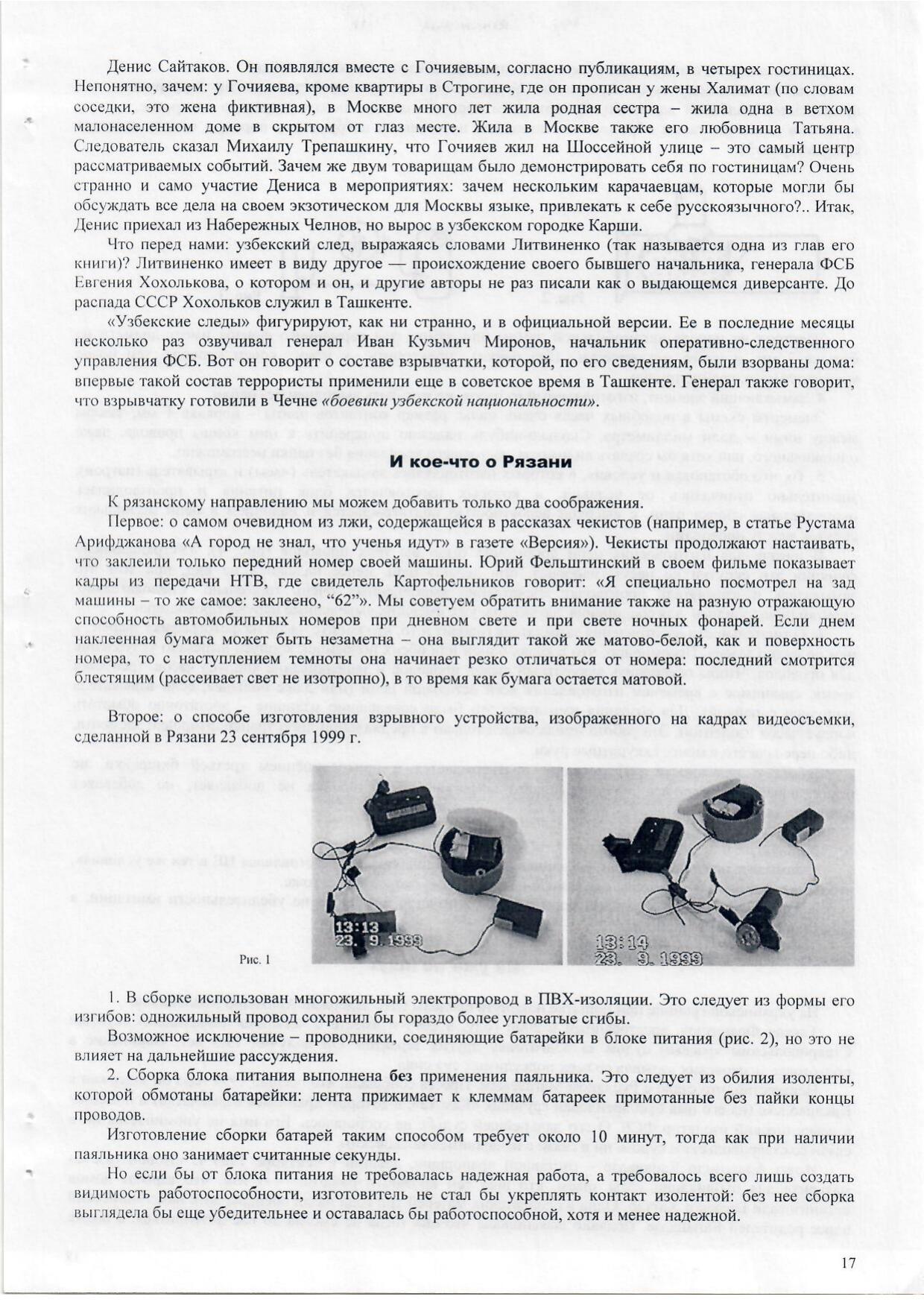
Второе: о способе изготовления взрывного устройства, изображенного на кадрах видеосъемки, сделанной в Рязани 23 сентября 1999 г.
[Рис. 1]
13:13 23. 9. 1999
13:14 23. 9. 1999
- В сборке использован многожильный электропровод в ПВХ-изоляции. Это следует из формы его изгибов: одножильный провод сохранил бы гораздо более угловатые сгибы.
Возможное исключение — проводники, соединяющие батарейки в блоке питания (рис. 2), но это не влияет на дальнейшие рассуждения. - Сборка блока питания выполнена без применения паяльника. Это следует из обилия изоленты, которой обмотаны батарейки: лента прижимает к клеммам батареек примотанные без пайки концы проводов.
Изготовление сборки батарей таким способом требует около 10 минут, тогда как при наличии паяльника оно занимает считанные секунды.
Но если бы от блока питания не требовалась надежная работа, а требовалось всего лишь создать видимость работоспособности, изготовитель не стал бы укреплять контакт изолентой: без нее сборка выглядела бы еще убедительнее и оставалась бы работоспособной, хотя и менее надежной.
17
Denis Saitakov and Gochiyayev
Denis Saitakov appeared together with Gochiyayev in four hotels, according to publications. The reasons for this are unclear:
- In addition to the apartment in Strogino, where he was registered with his wife Khalimat (according to a neighbor, this was a sham marriage), Gochiyayev's own sister had lived in Moscow for many years. She lived alone in a dilapidated, sparsely populated house in a secluded location.
- His mistress, Tatyana, also lived in Moscow.
- An investigator told Mikhail Trepashkin that Gochiyayev lived on Shosseinaya Street—the very center of the events under consideration.
The question remains: why would the two comrades show themselves in hotels? Denis's participation in the activities is also strange: why would several Karachays, who could discuss all their business in their own language (exotic for Moscow), attract a Russian-speaker to themselves? So, Denis arrived from Naberezhnye Chelny, but grew up in the Uzbek town of Karshi.
"Uzbek Trace"
What is presented is an "Uzbek trace," to use Litvinenko's words (this is the title of one of the chapters in his book). Litvinenko refers to something else—the origin of his former boss, FSB General Evgeny Khokholkov, about whom both he and other authors have repeatedly written as an outstanding saboteur. Before the collapse of the USSR, Khokholkov served in Tashkent.
"Uzbek traces" also appear, strangely enough, in the official version. General Ivan Kuzmich Mironov, head of the FSB's operational-investigative department, has voiced this several times in recent months. Here, he speaks about the composition of the explosives used to blow up the houses: according to his information, terrorists first used such a composition back in Soviet times in Tashkent. The general also says that the explosives were prepared in Chechnya by "militants of Uzbek nationality."
Considerations Regarding Ryazan
To the Ryazan direction, we can add only two considerations.
First Consideration: License Plate Evidence
This concerns the most obvious of the lies contained in the stories of the Chekists (for example, in Rustam Arifdzhanov's article "And the city did not know that exercises were underway" in the newspaper "Versiya").
- The Chekists continue to insist that they only taped over the front license plate of their car.
- Yuri Felshtinsky, in his film, shows footage from an NTV broadcast where witness Kartofelnikov says: "I specifically looked at the back of the car—the same thing: taped over, '62'."
- We also advise paying attention to the different reflectivity of car license plates in daylight and under night streetlights. If during the day the pasted paper might be unnoticeable—it looks just as matte-white as the surface of the plate—then with the onset of darkness, it begins to differ sharply from the plate: the latter looks shiny (it does not scatter light isotropically), while the paper remains matte.
Second Consideration: Explosive Device Manufacturing Method
This concerns the method of manufacturing the explosive device shown in the video footage taken in Ryazan on September 23, 1999.
[Fig. 1]
13:13 23. 9. 1999
13:14 23. 9. 1999
- Multi-strand electrical wire in PVC insulation was used in the assembly. This follows from the shape of its bends: a single-strand wire would have retained much more angular bends.
- A possible exception is the conductors connecting the batteries in the power supply unit (Fig. 2), but this does not affect further reasoning.
- The assembly of the power supply unit was performed without the use of a soldering iron. This follows from the abundance of electrical tape wrapped around the batteries: the tape presses the wire ends, wound without soldering, to the battery terminals.
- Making a battery assembly in this way takes about 10 minutes, whereas with a soldering iron, it takes a matter of seconds.
- However, if reliable operation was not required from the power supply unit, and it was only required to create the appearance of functionality, the manufacturer would not have reinforced the contact with electrical tape: without it, the assembly would look even more convincing and would remain functional, although less reliable.
17