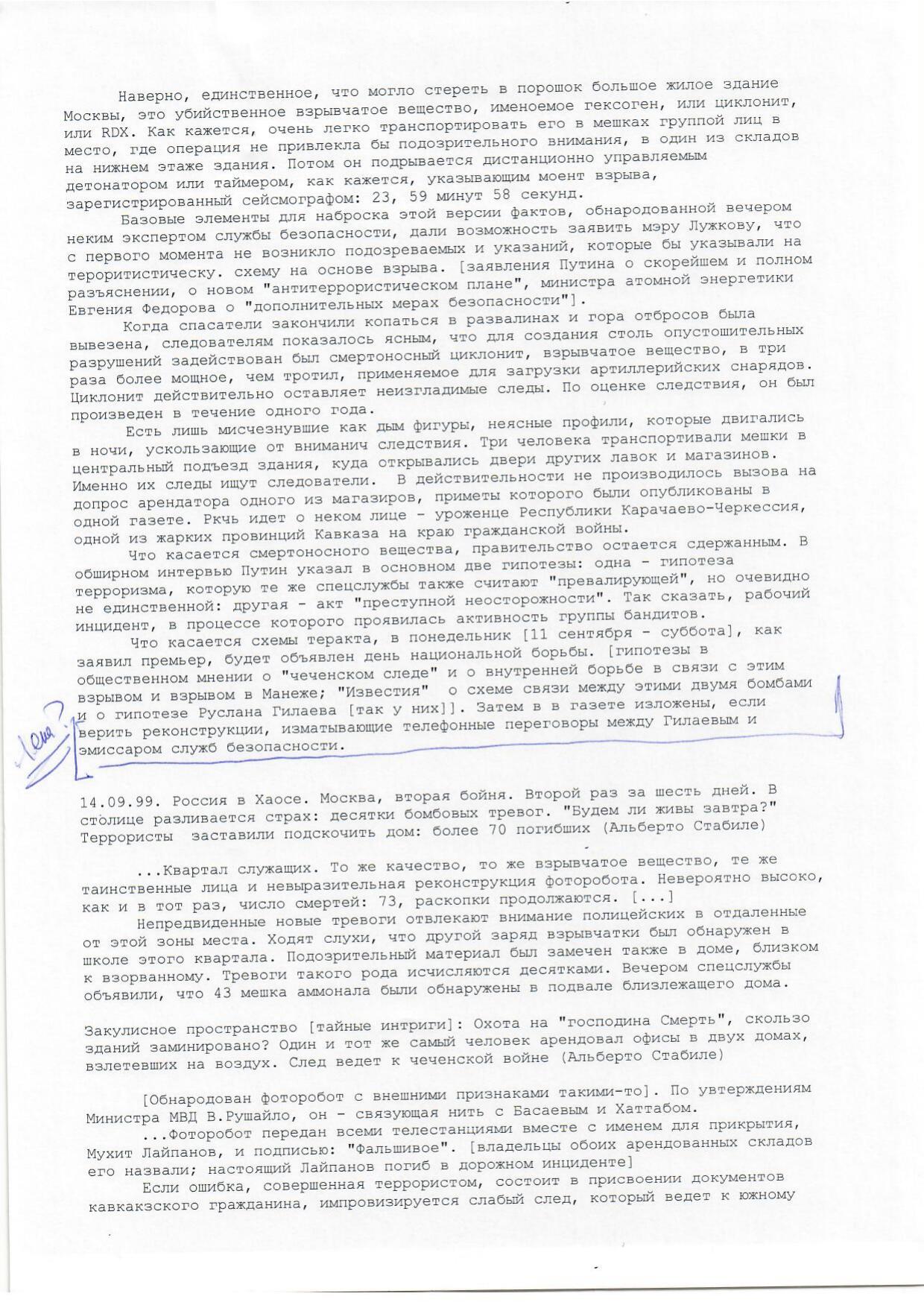
Наверно, единственное, что могло стереть в порошок большое жилое здание Москвы, это убийственное взрывчатое вещество, именуемое гексоген, или циклонит, или RDX. Как кажется, очень легко транспортировать его в мешках группой лиц в место, где операция не привлекла бы подозрительного внимания, в один из складов на нижнем этаже здания. Потом он подрывается дистанционно управляемым детонатором или таймером, как кажется, указывающим моент взрыва, зарегистрированный сейсмографом: 23, 59 минут 58 секунд.
Базовые элементы для наброска этой версии фактов, обнародованной вечером неким экспертом службы безопасности, дали возможность заявить мэру Лужкову, что с первого момента не возникло подозреваемых и указаний, которые бы указывали на тероиристическую. схему на основе взрыва. [заявления Путина о скорейшем и полном разъяснении, о новом "антитеррористическом плане", министра атомной энергетики Евгения Федорова о "дополнительных мерах безопасности"].
Когда спасатели закончили копаться в развалинах и гора отбросов была вывезена, следователям показалось ясным, что для создания столь опустошительных разрушений задействован был смертоносный циклонит, взрывчатое вещество, в три раза более мощное, чем тротил, применяемое для загрузки артиллерийских снарядов. Циклонит действительно оставляет неизгладимые следы. По оценке следствия, он был произведен в течение одного года.
Есть лишь мисчезнувшие как дым фигуры, неясные профили, которые двигались в ночи, ускользающие от внимания следствия. Три человека транспортировали мешки в центральный подъезд здания, куда открывались двери других лавок и магазинов. Именно их следы ищут следователи. В действительности не производилось вызова на допрос арендатора одного из магазинов, приметы которого были опубликованы в одной газете. Ркчь идет о неком лице - уроженце Республики Карачаево-Черкессия, одной из жарких провинций Кавказа на краю гражданской войны.
Что касается смертоносного вещества, правительство остается сдержанным. В обширном интервью Путин указал в основном две гипотезы: одна - гипотеза терроризма, которую те же спецслужбы также считают "превалирующей", но очевидно не единственной: другая - акт "преступной неосторожности". Так сказать, рабочий инцидент, в процессе которого проявилась активность группы бандитов.
Что касается схемы теракта, в понедельник [11 сентября - суббота], как заявил премьер, будет объявлен день национальной борьбы. [гипотезы в общественном мнении о "чеченском следе" и о внутренней борьбе в связи с этим взрывом и взрывом в Манеже; "Известия" о схеме связи между этими двумя бомбами и о гипотезе Руслана Гилаева [так у них]]. Затем в в газете изложены, если верить реконструкции, изматывающие телефонные переговоры между Гилаевым и эмиссаром служб безопасности.
14.09.99. Россия в Хаосе. Москва, вторая бойня. Второй раз за шесть дней. В столице разливается страх: десятки бомбовых тревог. "Будем ли живы завтра?" Террористы заставили подскочить дом: более 70 погибших (Альберто Стабиле)
...Квартал служащих. То же качество, то же взрывчатое вещество, те же таинственные лица и невыразительная реконструкция фоторобота. Невероятно высоко, как и в тот раз, число смертей: 73, раскопки продолжаются. [...]
Непредвиденные новые тревоги отвлекают внимание полицейских в отдаленные от этой зоны места. Ходят слухи, что другой заряд взрывчатки был обнаружен в школе этого квартала. Подозрительный материал был замечен также в доме, близком к взорванному. Тревоги такого рода исчисляются десятками. Вечером спецслужбы объявили, что 43 мешка аммонала были обнаружены в подвале близлежащего дома.
Закулисное пространство [тайные интриги]: Охота на "господина Смерть", сколько зданий заминировано? Один и тот же самый человек арендовал офисы в двух домах, взлетевших на воздух. След ведет к чеченской войне (Альберто Стабиле)
[Обнародован фоторобот с внешними признаками такими-то]. По увтерждениям Министра МВД В. Рушайло, он - связующая нить с Басаевым и Хаттабом.
...Фоторобот передан всеми телестанциями вместе с именем для прикрытия, Мухит Лайпанов, и подписью: "фальшивое". [владельцы обоих арендованных складов его назвали; настоящий Лайпанов погиб в дорожном инциденте]
Если ошибка, совершенная террористом, состоит в присвоении документов кавказского гражданина, импровизируется слабый след, который ведет к южному
Moscow Explosion Investigation Summary
Explosive Material and Incident Details
- The lethal explosive capable of pulverizing a large residential building in Moscow is identified as hexogen, cyclonite, or RDX.
- It appears easy for a group to transport the explosive in bags to a warehouse on the lower floor of the building without attracting suspicion.
- Detonation was achieved using a remote-controlled detonator or a timer, which recorded the explosion at 23 hours, 59 minutes, 58 seconds according to the seismograph.
- Investigators determined that lethal cyclonite, an explosive three times more powerful than TNT used for artillery shells, was used to cause the devastation.
- Cyclonite leaves indelible traces, and the investigation estimates it was produced within one year.
Official Statements and Initial Findings
- A security service expert released a sketch of the facts, allowing Mayor Luzhkov to state that initially, no suspects or indications pointed to a terrorist scheme.
- Putin called for a speedy and full explanation and a new "anti-terrorist plan."
- Minister of Atomic Energy Evgeny Fedorov mentioned "additional security measures."
Investigation Progress and Suspects
- Investigators noted that figures vanished like smoke, and profiles moved in the night, evading the investigation.
- Three people transported bags to the central entrance of the building, where other shops and stores were located; their tracks are being sought.
- No summons for interrogation was issued for the tenant of one store whose description was published in a newspaper.
- The person described is a native of the Republic of Karachay-Cherkessia, a region near the Caucasus known for civil unrest.
Government Hypotheses
- The government remains reserved regarding the lethal substance.
- Putin presented two main hypotheses:
- Terrorism, which security services also consider "prevailing."
- An act of "criminal negligence," essentially a work incident involving a group of bandits.
Political Context and Media Speculation
- On Monday (September 11 - Saturday), the Prime Minister announced a day of national struggle.
- Public opinion included hypotheses about a "Chechen trace" and internal struggles related to this explosion and the one in the Manege.
- Izvestia reported on a connection scheme between the two bombs and the hypothesis involving Ruslan Gelaev, detailing alleged exhaustive telephone conversations between Gelaev and a security services emissary.
Related Incidents and Security Concerns
- 14.09.99. Russia in Chaos. Moscow, second slaughter.
- The second incident in six days caused widespread fear in the capital, leading to dozens of bomb scares.
- The incident in the employees' quarter involved the same quality of explosive and mysterious faces.
- The death toll was extremely high (73, at the time of reporting).
- New alarms distracted police, and rumors suggested another explosive charge was found in a local school, along with suspicious material in a nearby house.
- Security services later announced that 43 bags of ammonal were found in the basement of a nearby house.
- Behind-the-scenes space [secret intrigues]: Hunting for "Mr. Death"
- Questions arose about how many buildings might be mined.
- The same person rented offices in two buildings that were blown up, leading the trail toward the Chechen war.
- A composite sketch was released, linking the individual to Basaev and Khattab, according to the Minister of Internal Affairs V. Rushailo.
- The composite sketch was broadcast with a cover name, Mukhit Laipanov, and the caption "fake." (The owners of both rented warehouses named him; the real Laipanov died in a road incident.)
- If the terrorist's mistake was appropriating the documents of a Caucasian citizen, a weak trail was improvised leading south.