Page 4 of 4
[Handwritten: Зачем!]
[Handwritten: ВВП]
[Handwritten: уровень прав-ва]
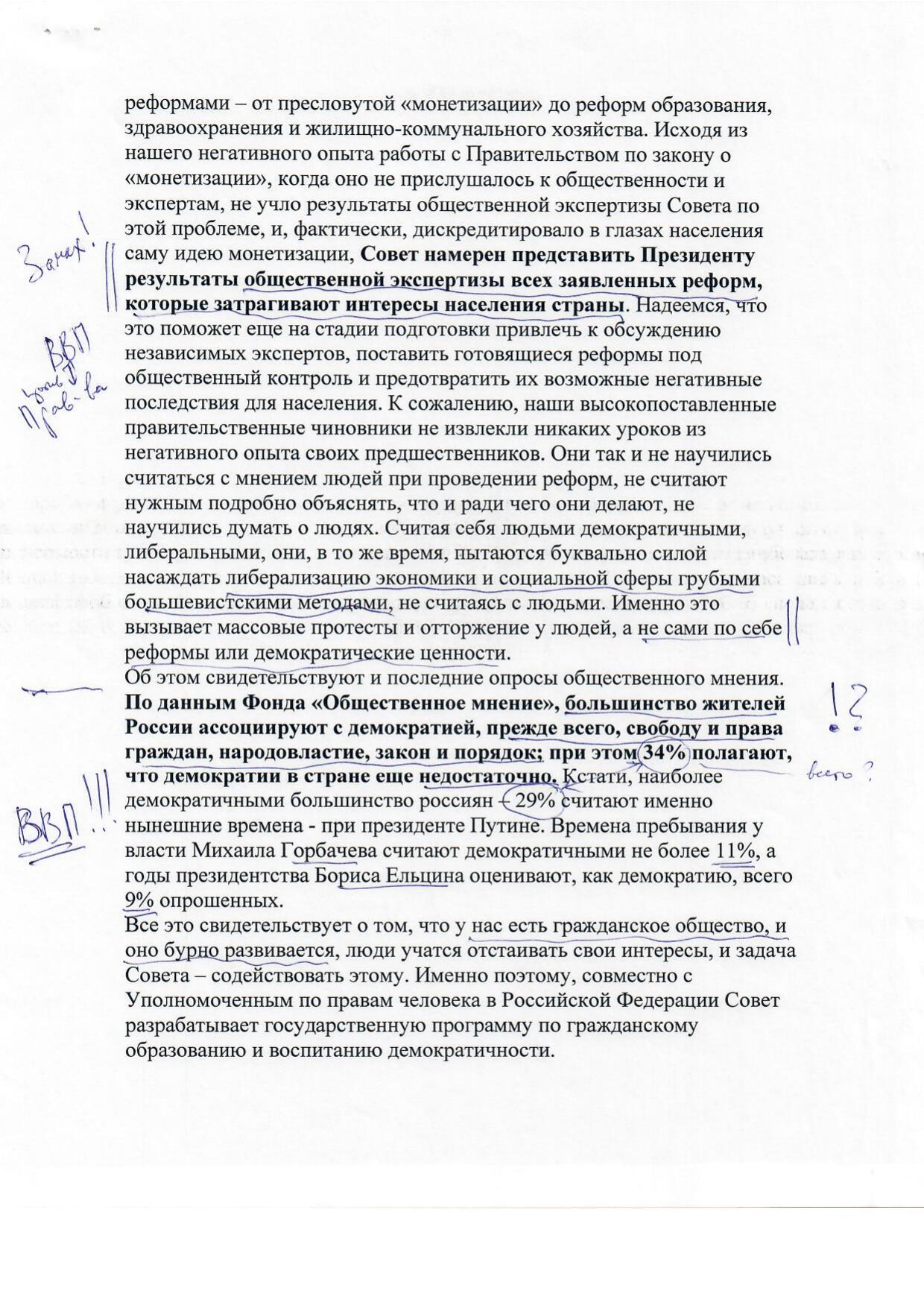
реформами – от пресловутой «монетизации» до реформ образования, здравоохранения и жилищно-коммунального хозяйства. Исходя из нашего негативного опыта работы с Правительством по закону о «монетизации», когда оно не прислушалось к общественности и экспертам, не учло результаты общественной экспертизы Совета по этой проблеме, и, фактически, дискредитировало в глазах населения саму идею монетизации, Совет намерен представить Президенту результаты общественной экспертизы всех заявленных реформ, которые затрагивают интересы населения страны. Надеемся, что это поможет еще на стадии подготовки привлечь к обсуждению независимых экспертов, поставить готовящиеся реформы под общественный контроль и предотвратить их возможные негативные последствия для населения. К сожалению, наши высокопоставленные правительственные чиновники не извлекли никаких уроков из негативного опыта своих предшественников. Они так и не научились считаться с мнением людей при проведении реформ, не считают нужным подробно объяснять, что и ради чего они делают, не научились думать о людях. Считая себя людьми демократичными, либеральными, они, в то же время, пытаются буквально силой насаждать либерализацию экономики и социальной сферы грубыми большевистскими методами, не считаясь с людьми. Именно это вызывает массовые протесты и отторжение у людей, а не сами по себе реформы или демократические ценности.
Об этом свидетельствуют и последние опросы общественного мнения. По данным Фонда «Общественное мнение», большинство жителей России ассоциируют с демократией, прежде всего, свободу и права граждан, народовластие, закон и порядок; при этом 34% полагают, что демократии в стране еще недостаточно. Кстати, наиболее [Handwritten: !?] демократичными большинство россиян – 29% считают именно [Handwritten: всего?] нынешние времена - при президенте Путине. [Handwritten: ВВП!!!] Времена пребывания у власти Михаила Горбачева считают демократичными не более 11%, а годы президентства Бориса Ельцина оценивают, как демократию, всего 9% опрошенных.
Все это свидетельствует о том, что у нас есть гражданское общество, и оно бурно развивается, люди учатся отстаивать свои интересы, и задача Совета – содействовать этому. Именно поэтому, совместно с Уполномоченным по правам человека в Российской Федерации Совет разрабатывает государственную программу по гражданскому образованию и воспитанию демократичности.
Why!
VVP
gov level
...reforms – from the notorious "monetization" to reforms in education, healthcare, and housing and communal services. Based on our negative experience of working with the Government on the law on "monetization," when it did not listen to the public and experts, did not take into account the results of the Council's public expertise on this issue, and, in fact, discredited the very idea of monetization in the eyes of the population, the Council intends to present to the President the results of the public expertise of all announced reforms that affect the interests of the country's population. We hope that this will help, even at the preparation stage, to involve independent experts in the discussion, place the reforms being prepared under public control, and prevent their possible negative consequences for the population. Unfortunately, our high-ranking government officials have not learned any lessons from the negative experience of their predecessors. They have still not learned to reckon with people's opinions when carrying out reforms, do not consider it necessary to explain in detail what they are doing and for what purpose, and have not learned to think about people. Considering themselves democratic, liberal people, they, at the same time, are trying to literally by force impose the liberalization of the economy and the social sphere using crude Bolshevik methods, without reckoning with people. It is this that causes mass protests and rejection among people, and not the reforms themselves or democratic values.
Public Opinion
This is also evidenced by recent public opinion polls. According to the Public Opinion Foundation, the majority of Russian residents associate democracy, first and foremost, with freedom and the rights of citizens, popular rule, and law and order; at the same time, 34% believe that there is still not enough democracy in the country. Incidentally, the majority of Russians – 29% – consider the current times, under President Putin, to be the most democratic. The times of Mikhail Gorbachev's stay in power are considered democratic by no more than 11%, and the years of Boris Yeltsin's presidency are assessed as democracy by only 9% of those surveyed.
Civil Society
All this testifies to the fact that we have a civil society, and it is developing rapidly; people are learning to defend their interests, and the Council's task is to facilitate this. That is why, together with the Human Rights Commissioner in the Russian Federation, the Council is developing a state program for civic education and the cultivation of democratic character.