Page 1 of 2
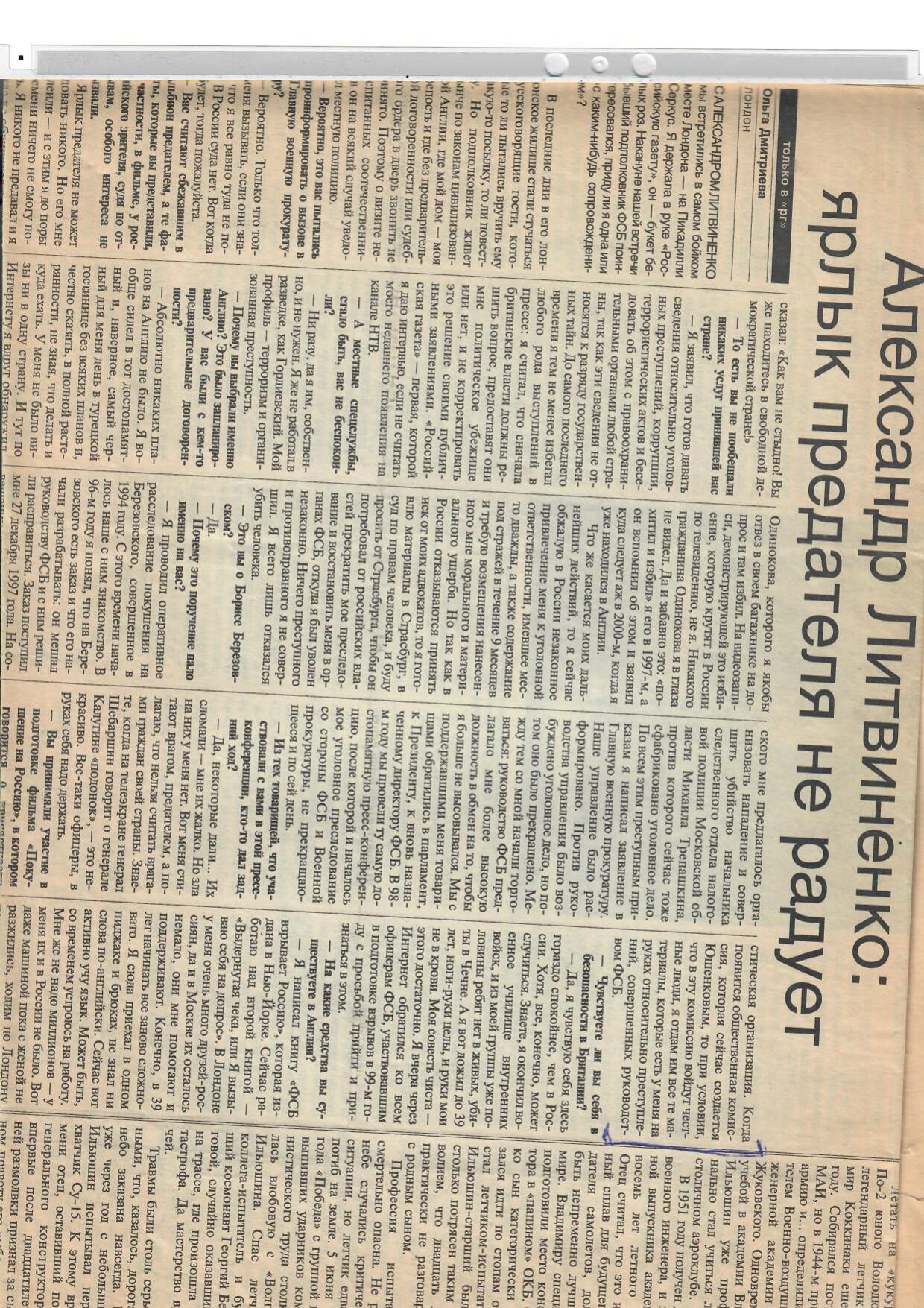
Александр Литвиненко: ярлык предателя не радует
Ольга Дмитриева, ЛОНДОН
С АЛЕКСАНДРОМ ЛИТВИНЕНКО мы встретились в самом бойком месте Лондона — на Пикадилли Серкус. Я держала в руке «Российскую газету», он — букет белых роз. Накануне нашей встречи бывший подполковник ФСБ поинтересовался, приду ли я одна или с каким-нибудь сопровождением?
В последние дни в его лондонское жилище стали стучаться ускороговорящие гости, которые то ли пытались вручить ему какую-то посылку, то ли повестку. Но подполковник живет сейчас по законам цивилизованной Англии, где мой дом — моя крепость и где без предварительной договоренности или судебного ордера в дверь звонить не принято. Поэтому о визите незваных гостей соответствующим образом на всякий случай уведомлена местная полиция.
— Вероятно, это вас пытались проинформировать о вызове в Главную военную прокуратуру?
— Вероятно. Только что толку меня вызывать, если они знают, что я все равно туда не поеду, пока суда не нет. Вот когда будет, тогда пожалуйста.
— Вас считают сбежавшим в Лондон предателем, а те факты, которые вы представили, в частности, в фильме, у российского зрителя, судя по отзывам, особого интереса не вызвали.
— Ярлык предателя не может радовать никого. Но его мне приклеили — и с этим я до поры до времени ничего не смогу поделать. Я никого не предавал и я сказал: «Как вам не стыдно! Вы же находитесь в свободной демократической стране!»
— То есть вы не пообещали никаких услуг приютившей вас стране?
— Я заявил, что готов давать сведения относительно уголовных преступлений, коррупции, террористических актов и беседовать об этом с правоохранительными органами любой страны, так как эти сведения не относятся к разряду государственных тайн. До самого последнего времени я тем не менее избегал любого рода выступлений в прессе: я считал, что сначала британские власти должны решить вопрос, предоставят они мне политическое убежище или нет, и не корректировать это решение своими публичными заявлениями. «Российская газета» — первая, которой я даю интервью, если не считать моего недавнего появления на канале НТВ.
— А местные спецслужбы, стало быть, вас не беспокоили?
— Ни разу, да я им, собственно, и не нужен. Я же не работал в разведке, как Гордиевский. Мой профиль — терроризм и организованная преступность.
— Почему вы выбрали именно Англию? Это было запланировано? У вас были с кем-то предварительные договоренности?
— Абсолютно никаких планов на Англию не было. Я вообще сидел в тот достопамятный и, наверное, самый черный для меня день в турецкой гостинице без всяких планов и, честно сказать, в полной растерянности, не зная, что делать и куда ехать. У меня не было визы ни в одну страну. И тут по Интернету я вдруг обнаружил Одинокова, которого я якобы отвез в своем багажнике на допрос и там избил. На видеозаписи, демонстрирующей это избиение, которую крутят в России по телевидению, не я. Никакого гражданина Одинокова я в глаза не видел. Да и забавно это: «похитил и избил» я его в 1997-м, а он вспомнил об этом и заявил куда следует аж в 2000-м, когда я уже находился в Англии.
Что же касается моих дальнейших действий, то я сейчас обжалую в России незаконное привлечение меня к уголовной ответственности, имевшее место дважды, а также содержание под стражей в течение 9 месяцев и требую возмещения нанесенного мне морального и материального ущерба. Но так как в России отказываются принять иск от моих адвокатов, то я готовлю материалы в Страсбург, в суд по правам человека, и буду просить от Страсбурга, чтобы он потребовал от российских властей прекратить мое преследование и восстановить меня в органах ФСБ, откуда я был уволен незаконно. Ничего преступного и противоправного я не совершил. Я всего лишь отказался убить человека.
— Это вы о Борисе Березовском?
— Да.
— Почему это поручение пало именно на вас?
— Я проводил оперативное расследование покушения на Березовского, совершенное в 1994 году. С этого времени началось наше с ним знакомство. В 96-м году я понял, что на Березовского есть заказ и что его начали разрабатывать: он мешал руководству ФСБ и с ним решили расправиться. Заказ поступил мне 27 декабря 1997 года. На совете мне предлагалось организовать нападение и совершить убийство начальника следственного отдела налоговой полиции Московской области Михаила Трепашкина, против которого сейчас тоже сфабриковано уголовное дело. По всем этим преступным приказам я написал заявление в Главную военную прокуратуру. Наше управление было расформировано. Против руководства управления было возбуждено уголовное дело, но потом оно было прекращено. Между тем со мной начали торговаться: руководство ФСБ предлагало мне более высокую должность в обмен на то, чтобы я больше не высовывался. Мы с поддерживавшими меня товарищами обратились в парламент, к Президенту, я вновь назначенному директору ФСБ. В 98-м году мы провели ту самую достопамятную пресс-конференцию, после которой и началось мое уголовное преследование со стороны ФСБ и Военной прокуратуры, не прекращающееся и по сей день.
— Из тех товарищей, что участвовали с вами в этой пресс-конференции, кто-то дал задний ход?
— Да, некоторые дали... Их сломали — мне их жалко. Но зла на них у меня нет. Вот меня считают врагом, предателем, а я полагаю, что нельзя считать врагами граждан своей страны. Знаете, когда на телеэкране генерал Шебаршин говорит о генерале Калугине «подонок», — это некрасиво. Все-таки офицеры, в руках себя надо держать.
— Вы принимали участие в подготовке фильма «Покушение на Россию», в котором говорится...
— На какие средства вы существуете в Англии?
— Я написал книгу «ФСБ взрывает Россию», которая издана в Нью-Йорке. Сейчас работаю над второй книгой — «Выдернутая чека, или Я вызываю себя на допрос». В Лондоне у меня очень много друзей-россиян, да и в Москве их осталось немало, они мне помогают и поддерживают. Конечно, в 39 лет начинать все заново сложно. Я сюда приехал в одном пиджаке и брюках, не зная ни слова по-английски. Сейчас вот активно учу язык. Может быть, со временем устроюсь на работу. Мне же не надо миллионов — у меня их в России не было. Вот даже машиной пока с женой не разжились, ходим по Лондону пешком.
— Чувствуете ли вы себя в безопасности в Британии?
— Да, я чувствую себя здесь гораздо спокойнее, чем в России. Хотя, все, конечно, может случиться. Знаете, я окончил военное училище внутренних войск, и из моей группы уже половина ребят нет в живых, убиты в Чечне. А я вот дожил до 39 лет, ноги-руки целы, и руки мои не в крови. Моя совесть чиста — этого достаточно. Я вчера через Интернет обратился ко всем офицерам ФСБ, участвовавшим в подготовке взрывов в 99-м году с просьбой прийти и признаться в этом.
Alexander Litvinenko: The label of a traitor does not please
Olga Dmitrieva, LONDON
I met Alexander Litvinenko in the busiest place in London — at Piccadilly Circus. I held a copy of "Rossiyskaya Gazeta" in my hand, and he held a bouquet of white roses. On the eve of our meeting, the former FSB lieutenant colonel asked if I would come alone or with some kind of accompaniment?
In recent days, fast-talking guests have started knocking on his London home, either trying to hand him some kind of package or a summons. But the lieutenant colonel now lives according to the laws of civilized England, where my home is my castle and where it is not customary to ring the doorbell without a prior arrangement or a court warrant. Therefore, the local police have been notified accordingly about the visit of uninvited guests just in case.
- — Probably, they were trying to inform you about a summons to the Main Military Prosecutor's Office?
- — Probably. But what's the point of summoning me if they know that I won't go there anyway until there's a trial. When there is one, then please.
- — You are considered a traitor who fled to London, and the facts you presented, in particular, in the film, did not arouse much interest among the Russian audience, judging by the reviews.
- — The label of a traitor cannot please anyone. But it was stuck on me — and for the time being, I can't do anything about it. I didn't betray anyone and I said: "How can you not be ashamed! You are in a free democratic country!"
- — That is, you didn't promise any services to the country that sheltered you?
- — I stated that I am ready to provide information regarding criminal offenses, corruption, terrorist acts and talk about it with law enforcement agencies of any country, as this information does not belong to the category of state secrets. Until the very last moment, I nevertheless avoided any kind of appearances in the press: I believed that first the British authorities should decide whether they would grant me political asylum or not, and not correct this decision with my public statements. "Rossiyskaya Gazeta" is the first one I'm giving an interview to, not counting my recent appearance on the NTV channel.
- — So, the local special services didn't bother you?
- — Not once, and I don't really need them. I didn't work in intelligence like Gordievsky. My profile is terrorism and organized crime.
- — Why did you choose England? Was it planned? Did you have any preliminary agreements with anyone?
- — There were absolutely no plans for England. I was sitting in that memorable and probably the blackest day for me in a Turkish hotel without any plans and, to be honest, in complete confusion, not knowing what to do and where to go. I didn't have a visa for any country. And then on the Internet I suddenly discovered Odinokov, whom I allegedly took in my trunk for interrogation and beat there. In the video recording demonstrating this beating, which is being played on television in Russia, it's not me. I've never seen any citizen Odinokov. And it's funny: I "kidnapped and beat" him in 1997, and he remembered it and reported it where necessary as late as 2000, when I was already in England.
As for my further actions, I am now appealing in Russia against the illegal criminal prosecution that took place twice, as well as detention for 9 months, and I demand compensation for the moral and material damage caused to me. But since they refuse to accept the lawsuit from my lawyers in Russia, I am preparing materials for Strasbourg, for the Court of Human Rights, and I will ask Strasbourg to demand that the Russian authorities stop my persecution and reinstate me in the FSB bodies, from where I was illegally dismissed. I have committed nothing criminal or illegal. I just refused to kill a person.
- — Are you talking about Boris Berezovsky?
- — Yes.
- — Why did this assignment fall on you?
-
— I conducted an operational investigation into the assassination attempt on Berezovsky, committed in 1994. Since then, our acquaintance with him began. In '96, I realized that there was a contract out on Berezovsky and that they had started working on him: he was interfering with the FSB leadership and they decided to deal with him. The order came to me on December 27, 1997. At the meeting, I was offered to organize an attack and commit the murder of the head of the investigative department of the tax police of the Moscow region, Mikhail Trepashkin, against whom a criminal case is also being fabricated now. Regarding all these criminal orders, I wrote a statement to the Main Military Prosecutor's Office. Our department was disbanded. A criminal case was opened against the management of the department, but then it was closed. Meanwhile, they started bargaining with me: the FSB leadership offered me a higher position in exchange for me not sticking my neck out anymore. My comrades who supported me and I turned to the parliament, to the President, to the newly appointed director of the FSB. In '98, we held that very memorable press conference, after which my criminal prosecution by the FSB and the Military Prosecutor's Office began, which has not stopped to this day.
-
— Of those comrades who participated with you in that press conference, did anyone back down?
- — Yes, some did... They were broken — I feel sorry for them. But I have no malice towards them. Here I am considered an enemy, a traitor, but I believe that citizens of one's own country cannot be considered enemies. You know, when General Shebarshin calls General Kalugin a "scumbag" on the TV screen, it's ugly. After all, they are officers, they should keep themselves in check.
- — You took part in the preparation of the film "Assassination of Russia", in which it is said...
- — On what funds do you exist in England?
- — I wrote the book "FSB Blows Up Russia", which was published in New York. Now I'm working on the second book — "The Pulled Pin, or I Summon Myself for Interrogation". In London, I have a lot of Russian friends, and there are quite a few of them left in Moscow, they help and support me. Of course, at 39, starting all over again is difficult. I came here in one jacket and trousers, not knowing a word of English. Now I'm actively learning the language. Maybe, over time, I'll get a job. I don't need millions — I didn't have them in Russia. We haven't even acquired a car with my wife yet, we walk around London on foot.
- — Do you feel safe in Britain?
- — Yes, I feel much safer here than in Russia. Although, of course, anything can happen. You know, I graduated from a military school of the internal troops, and half of the guys from my group are no longer alive, killed in Chechnya. And I lived to be 39, my legs and arms are intact, and my hands are not in blood. My conscience is clear — that's enough. Yesterday, via the Internet, I appealed to all FSB officers who participated in the preparation of the explosions in '99 with a request to come and confess to it.