P.S. „Комитет по правам человека,“ — решил вам дать охрану,“ — сказал мне Юшенков С.Н., на встрече со мною. И они (охрана) днём и ночью ходили за мною. Первый вопрос на суде был задан мне: „Как вам удалось выйти на свободу из Лефортово?“ „Кто у вас знакомые в вышестоящих кругах?“ Мой адвокат-горе так и не понял причины мягкого обхождения со мной в 1-й день. А он состоял в комиссии судивших: „А что, если у подсудимого действительно такие связи, что?!?!“ Отсюда и их благополучие судебного процесса в 1-й день... А дальше: мне судья Марова отдала паспорт, сказав: „Всё, что я могу сделать!“ А дальше: меня хотели арестовать; но меня охрана „отбила“ (а может: это был хорошо поставленный спектакль) и вывезла за пределы России. Суд шёл без меня. Без меня судили и вынесли приговор и определение вопреки законам всем, Конституции, УПК и прав человека. Мне в это время на Украине выбивали зубы и таскали по тюрьмам, [illegible] (13 тюрем сменил за 6 месяцев).
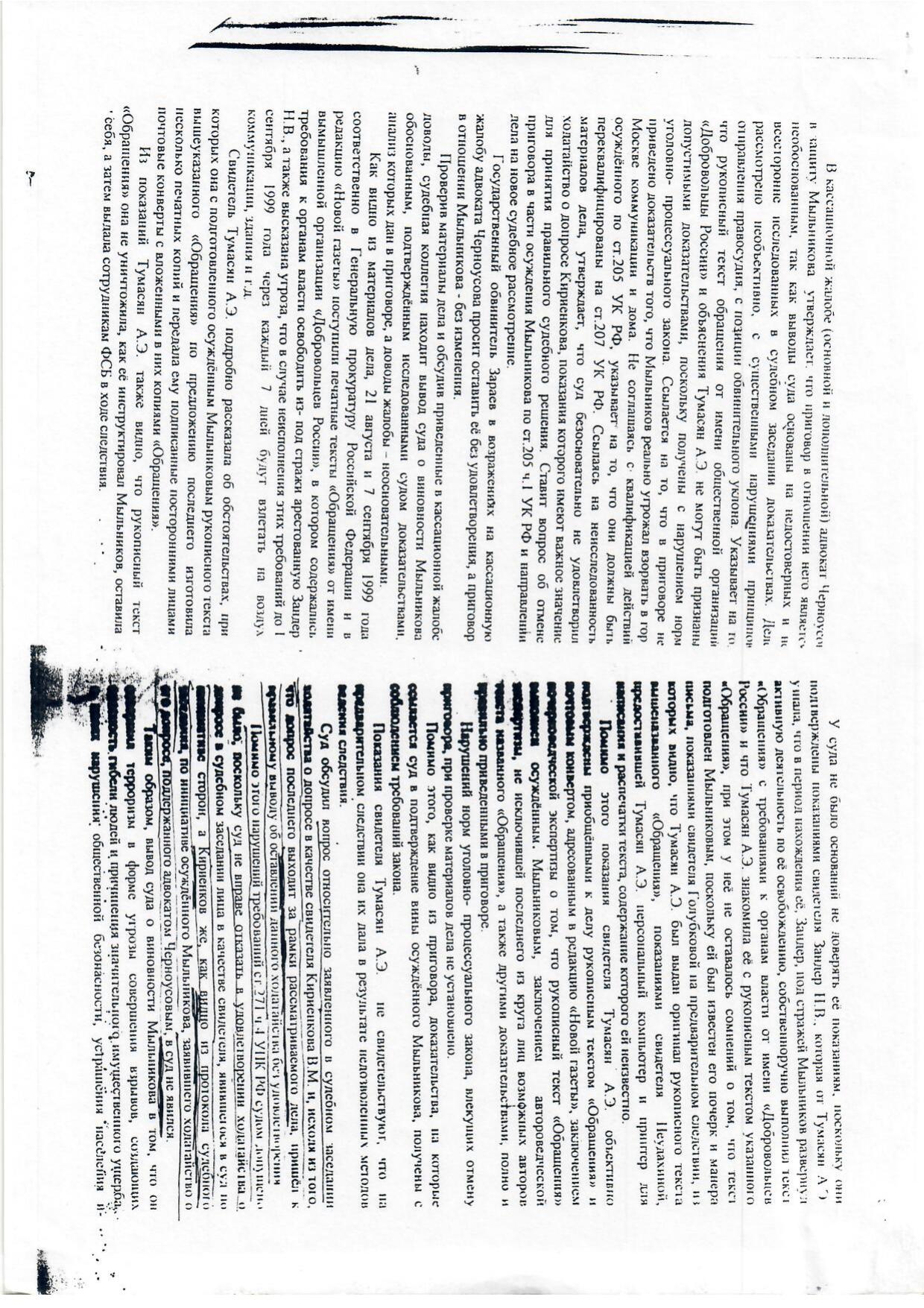
Cassation Appeal Review
Arguments of Lawyer Chernousov (Defense of Mylnikov)
Lawyer Chernousov, in defense of Mylnikov, asserts the following in the cassation appeal (main and supplementary):
- The sentence against Mylnikov is unfounded because the court's conclusions are based on unreliable evidence that was not comprehensively examined during the trial.
- The case was handled non-objectively, with significant violations of the principles of justice and from a position of prosecutorial bias.
- The handwritten text of the appeal on behalf of the public organization "Volunteers of Russia" and the explanations of Tumasian A.E. cannot be recognized as admissible evidence because they were obtained in violation of the norms of criminal procedure law.
- The sentence provides no evidence that Mylnikov actually threatened to blow up communications and houses in the city of Moscow.
- He disagrees with the classification of the convict's actions under Article 205 of the Criminal Code of the Russian Federation, arguing they should be reclassified under Article 207 of the Criminal Code of the Russian Federation.
- Citing the lack of investigation into the case materials, he asserts that the court groundlessly denied the motion to interrogate Kirienkov, whose testimony is of great importance for making a correct judicial decision.
- He raises the issue of overturning the sentence regarding Mylnikov's conviction under Article 205, Part 1 of the Criminal Code of the Russian Federation and remanding the case for a new trial.
State Prosecutor's Objection
State prosecutor Zaras, in objections to lawyer Chernousov's cassation appeal, requests that it be denied and that the sentence against Mylnikov remain unchanged.
Judicial Collegium Findings
Having reviewed the case materials and discussed the arguments presented in the cassation appeal, the judicial collegium finds:
- The court's conclusion regarding Mylnikov's guilt to be well-founded, confirmed by evidence examined by the court and analyzed in the sentence.
- The arguments of the appeal to be groundless.
Evidence Review
- On August 21 and September 7, 1999, respectively, the Prosecutor General's Office of the Russian Federation and the editorial office of "Novaya Gazeta" received printed texts of an "Appeal" on behalf of a fictional organization "Volunteers of Russia."
- This appeal contained demands for the authorities to release the arrested N.V. Zander from custody and expressed a threat that if these demands were not met by September 1, 1999, communications, buildings, etc., would be blown up every 7 days.
- Witness Tumasian A.E. described producing several printed copies from a handwritten text of the aforementioned "Appeal," prepared by Mylnikov, at his suggestion, and gave him postal envelopes signed by third parties containing copies of the "Appeal."
- Tumasian A.E. testified that she did not destroy the handwritten text of the "Appeal" as instructed by Mylnikov, but kept it and later handed it over to FSB officers during the investigation.
- The court found no reason to distrust Tumasian A.E.'s testimony because it is confirmed by:
- The testimony of witness N.V. Zander, who learned from Tumasian A.E. that Mylnikov actively sought her release, personally wrote the text of the "Appeal" with demands on behalf of the "Volunteers of Russia," and showed her the handwritten text. Zander had no doubt the text was prepared by Mylnikov, as she was familiar with his handwriting and writing style.
- The testimony of witness Golubova during the preliminary investigation, which shows that Tumasian A.E. was given the original handwritten text of the aforementioned "Appeal."
- The testimony of witness Neudakhina, who provided Tumasian A.E. with a personal computer and printer to write and print the text, the content of which was unknown to her.
- Additionally, Tumasian A.E.'s testimony is objectively confirmed by:
- The handwritten text of the "Appeal" and the postal envelope addressed to the editorial office of "Novaya Gazeta" attached to the case.
- The conclusion of a handwriting expert that the handwritten text of the "Appeal" was written by the convict Mylnikov.
- The conclusion of an authorship expert who did not exclude Mylnikov from the circle of possible authors of the text of the named "Appeal."
- Other evidence fully and correctly cited in the sentence.
Procedural Review
- No violations of the norms of criminal procedure law entailing the reversal of the sentence were established during the review of the case materials.
- The evidence cited by the court to confirm Mylnikov's guilt was obtained in compliance with the requirements of the law.
- Tumasian A.E.'s testimony does not indicate that she gave it during the preliminary investigation as a result of unlawful methods of investigation.
- The court discussed the motion filed during the trial to interrogate B.M. Kirienkov as a witness and, based on the fact that the interrogation falls outside the scope of the case under consideration, reached the correct conclusion to deny this motion.
- There were no violations of the requirements of Article 277, Part 4 of the Criminal Procedure Code of the Russian Federation by the court, as the court does not have the right to refuse a motion to interrogate a person as a witness in a court session initiated by the parties, whereas Kirienkov, as seen from the trial transcript, did not appear in court at the initiative of Mylnikov, who filed the motion for his interrogation, supported by lawyer Chernousov.
Conclusion
Thus, the court's conclusion regarding Mylnikov's guilt in committing terrorism in the form of a threat to carry out explosions that create a danger of loss of life and significant property damage, for the purpose of violating public safety, intimidating the population and...