Page 2 of 2
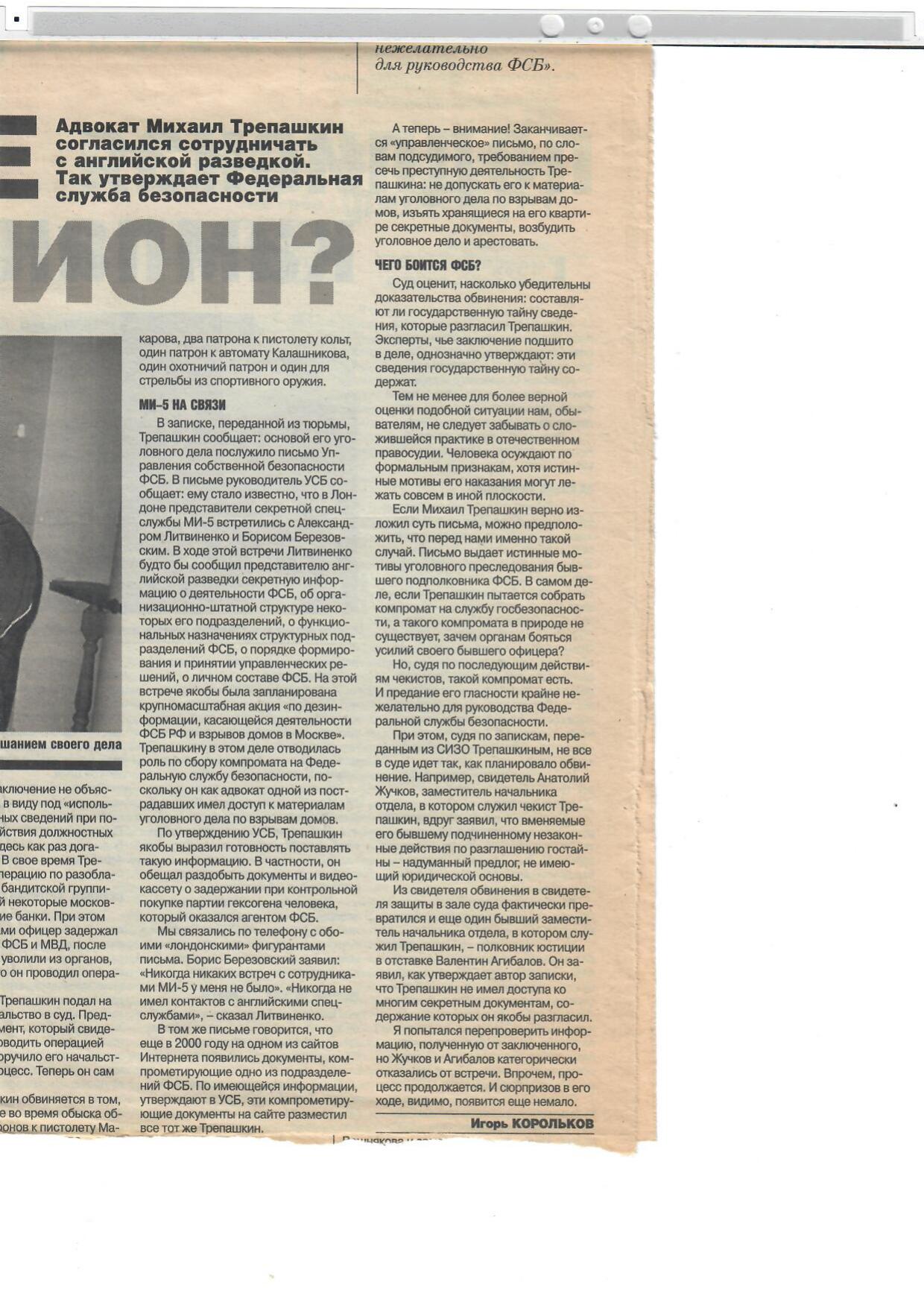
Адвокат Михаил Трепашкин согласился сотрудничать с английской разведкой. Так утверждает Федеральная служба безопасности
[ШП]ИОН?
...карова, два патрона к пистолету кольт, один патрон к автомату Калашникова, один охотничий патрон и один для стрельбы из спортивного оружия.
МИ-5 НА СВЯЗИ
В записке, переданной из тюрьмы, Трепашкин сообщает: основой его уголовного дела послужило письмо Управления собственной безопасности ФСБ. В письме руководитель УСБ сообщает: ему стало известно, что в Лондоне представители секретной спецслужбы МИ-5 встретились с Александром Литвиненко и Борисом Березовским. В ходе этой встречи Литвиненко будто бы сообщил представителю английской разведки секретную информацию о деятельности ФСБ, об организационно-штатной структуре некоторых его подразделений, о функциональных назначениях структурных подразделений ФСБ, о порядке формирования и принятии управленческих решений, о личном составе ФСБ. На этой встрече якобы была запланирована крупномасштабная акция «по дезинформации, касающейся деятельности ФСБ РФ и взрывов домов в Москве». Трепашкину в этом деле отводилась роль по сбору компромата на Федеральную службу безопасности, поскольку он как адвокат одной из пострадавших имел доступ к материалам уголовного дела по взрывам домов.
По утверждению УСБ, Трепашкин якобы выразил готовность поставлять такую информацию. В частности, он обещал раздобыть документы и видеокассету о задержании при контрольной покупке партии гексогена человека, который оказался агентом ФСБ.
Мы связались по телефону с обоими «лондонскими» фигурантами письма. Борис Березовский заявил: «Никогда никаких встреч с сотрудниками МИ-5 у меня не было». «Никогда не имел контактов с английскими спецслужбами», — сказал Литвиненко.
В том же письме говорится, что еще в 2000 году на одном из сайтов Интернета появились документы, компрометирующие одно из подразделений ФСБ. По имеющейся информации, утверждают в УСБ, эти компрометирующие документы на сайте разместил все тот же Трепашкин.
нежелательно для руководства ФСБ».
А теперь — внимание! Заканчивается «управленческое» письмо, по словам подсудимого, требованием пресечь преступную деятельность Трепашкина: не допускать его к материалам уголовного дела по взрывам домов, изъять хранящиеся на его квартире секретные документы, возбудить уголовное дело и арестовать.
ЧЕГО БОИТСЯ ФСБ?
Суд оценит, насколько убедительны доказательства обвинения: составляют ли государственную тайну сведения, которые разгласил Трепашкин. Эксперты, чье заключение подшито в деле, однозначно утверждают: эти сведения государственную тайну содержат.
Тем не менее для более верной оценки подобной ситуации нам, обывателям, не следует забывать о сложившейся практике в отечественном правосудии. Человека осуждают по формальным признакам, хотя истинные мотивы его наказания могут лежать совсем в иной плоскости.
Если Михаил Трепашкин верно изложил суть письма, можно предположить, что перед нами именно такой случай. Письмо выдает истинные мотивы уголовного преследования бывшего подполковника ФСБ. В самом деле, если Трепашкин пытается собрать компромат на службу госбезопасности, а такого компромата в природе не существует, зачем органам бояться усилий своего бывшего офицера?
Но, судя по последующим действиям чекистов, такой компромат есть. И предание его гласности крайне нежелательно для руководства Федеральной службы безопасности.
При этом, судя по запискам, переданным из СИЗО Трепашкиным, не все в суде идет так, как планировало обвинение. Например, свидетель Анатолий Жучков, заместитель начальника отдела, в котором служил чекист Трепашкин, вдруг заявил, что вменяемые его бывшему подчиненному незаконные действия по разглашению гостайны — надуманный предлог, не имеющий юридической основы.
Из свидетеля обвинения в свидетеля защиты в зале суда фактически превратился и еще один бывший заместитель начальника отдела, в котором служил Трепашкин, — полковник юстиции в отставке Валентин Агибалов. Он заявил, как утверждает автор записки, что Трепашкин не имел доступа ко многим секретным документам, содержание которых он якобы разгласил.
Я попытался перепроверить информацию, полученную от заключенного, но Жучков и Агибалов категорически отказались от встречи. Впрочем, процесс продолжается. И сюрпризов в его ходе, видимо, появится еще немало.
Игорь КОРОЛЬКОВ
Lawyer Mikhail Trepashkin Cooperates with British Intelligence
Lawyer Mikhail Trepashkin agreed to cooperate with British intelligence, so claims the Federal Security Service.
[SP]Y?
...[Ma]karov, two cartridges for a Colt pistol, one cartridge for a Kalashnikov assault rifle, one hunting cartridge, and one for shooting from a sporting weapon.
MI-5 ON THE LINE
In a note sent from prison, Trepashkin reports: the basis of his criminal case was a letter from the FSB's Internal Security Directorate (USB). In the letter, the head of the USB reports: it became known to him that in London, representatives of the secret service MI-5 met with Alexander Litvinenko and Boris Berezovsky. During this meeting, Litvinenko allegedly provided the British intelligence representative with secret information about:
- The activities of the FSB.
- The organizational and staff structure of some of its units.
- The functional purposes of the FSB's structural units.
- The procedure for forming and making management decisions.
- The personnel of the FSB.
At this meeting, a large-scale action "on disinformation concerning the activities of the FSB of the Russian Federation and the apartment bombings in Moscow" was allegedly planned. Trepashkin was assigned the role in this matter of collecting compromising material on the Federal Security Service, since he, as a lawyer for one of the victims, had access to the materials of the criminal case on the apartment bombings.
According to the USB, Trepashkin allegedly expressed readiness to supply such information. In particular, he promised to obtain documents and a videotape of the detention during a controlled purchase of a batch of hexogen of a person who turned out to be an FSB agent.
We contacted both "London" figures of the letter by phone. Boris Berezovsky stated: "I never had any meetings with MI-5 officers." "I never had contacts with British special services," said Litvinenko.
The same letter says that back in 2000, documents compromising one of the FSB units appeared on one of the Internet sites. According to available information, the USB claims, these compromising documents were posted on the site by the same Trepashkin.
"undesirable for the FSB leadership."
And now — attention! The "management" letter ends, according to the defendant, with a demand to stop Trepashkin's criminal activities: not to allow him access to the materials of the criminal case on the apartment bombings, to seize secret documents stored in his apartment, to initiate a criminal case and arrest him.
WHAT IS THE FSB AFRAID OF?
The court will assess how convincing the prosecution's evidence is: whether the information disclosed by Trepashkin constitutes a state secret. Experts, whose conclusion is filed in the case, unequivocally state: this information contains a state secret.
Nevertheless, for a more correct assessment of such a situation, we, the laypeople, should not forget about the established practice in domestic justice. A person is convicted on formal grounds, although the true motives for his punishment may lie in a completely different plane.
If Mikhail Trepashkin correctly outlined the essence of the letter, it can be assumed that we are facing exactly such a case. The letter reveals the true motives for the criminal prosecution of the former FSB lieutenant colonel. Indeed, if Trepashkin is trying to collect compromising material on the state security service, and such compromising material does not exist in nature, why should the authorities fear the efforts of their former officer?
But, judging by the subsequent actions of the Chekists, such compromising material exists. And making it public is extremely undesirable for the leadership of the Federal Security Service.
At the same time, judging by the notes sent from the SIZO by Trepashkin, not everything in court is going as the prosecution planned. For example, witness Anatoly Zhukov, deputy head of the department in which the Chekist Trepashkin served, suddenly stated that the illegal actions of disclosing state secrets imputed to his former subordinate are a far-fetched pretext that has no legal basis.
Another former deputy head of the department in which Trepashkin served, retired Colonel of Justice Valentin Agibalov, actually turned from a prosecution witness into a defense witness in the courtroom. He stated, as the author of the note claims, that Trepashkin did not have access to many secret documents, the contents of which he allegedly disclosed.
I tried to double-check the information received from the prisoner, but Zhukov and Agibalov categorically refused to meet. However, the process continues. And many more surprises will likely appear in its course.
Igor KOROLKOV