Page 1 of 2
2 № 101 (284)
20 мая 2004 года, четверг
События
Адвокат пострадал за секретные материалы
Елена АПАСОВА
19.05.
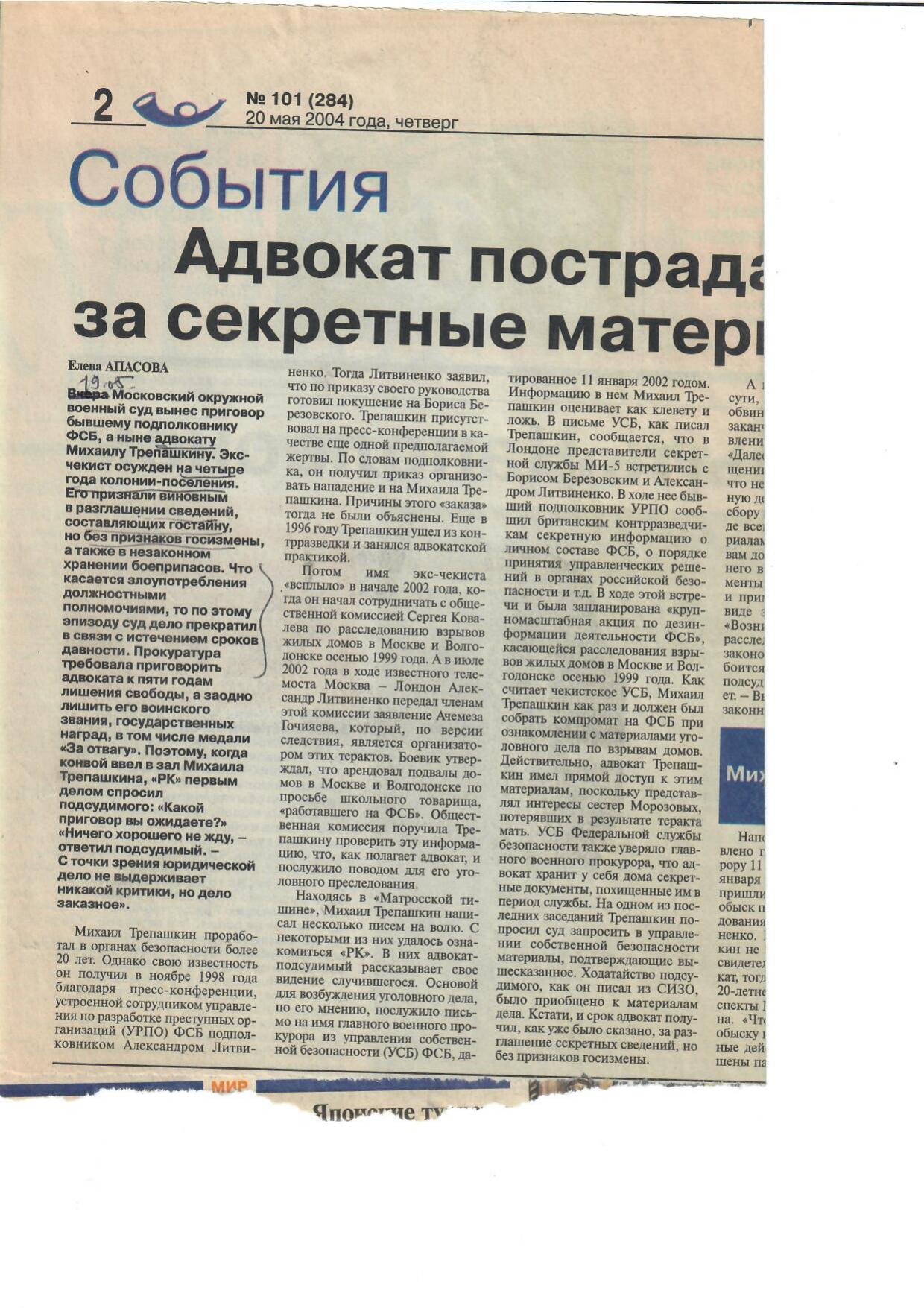
Вчера Московский окружной военный суд вынес приговор бывшему подполковнику ФСБ, а ныне адвокату Михаилу Трепашкину. Экс-чекист осужден на четыре года колонии-поселения. Его признали виновным в разглашении сведений, составляющих гостайну, но без признаков госизмены, а также в незаконном хранении боеприпасов. Что касается злоупотребления должностными полномочиями, то по этому эпизоду суд дело прекратил в связи с истечением сроков давности. Прокуратура требовала приговорить адвоката к пяти годам лишения свободы, а заодно лишить его воинского звания, государственных наград, в том числе медали «За отвагу». Поэтому, когда конвой ввел в зал Михаила Трепашкина, «РК» первым делом спросил подсудимого: «Какой приговор вы ожидаете?» «Ничего хорошего не жду, — ответил подсудимый. — С точки зрения юридической дело не выдерживает никакой критики, но дело заказное».
Михаил Трепашкин проработал в органах безопасности более 20 лет. Однако свою известность он получил в ноябре 1998 года благодаря пресс-конференции, устроенной сотрудником управления по разработке преступных организаций (УРПО) ФСБ подполковником Александром Литвиненко. Тогда Литвиненко заявил, что по приказу своего руководства готовил покушение на Бориса Березовского. Трепашкин присутствовал на пресс-конференции в качестве еще одной предполагаемой жертвы. По словам подполковника, он получил приказ организовать нападение и на Михаила Трепашкина. Причины этого «заказа» тогда не были объяснены. Еще в 1996 году Трепашкин ушел из контрразведки и занялся адвокатской практикой.
Потом имя экс-чекиста «всплыло» в начале 2002 года, когда он начал сотрудничать с общественной комиссией Сергея Ковалева по расследованию взрывов жилых домов в Москве и Волгодонске осенью 1999 года. А в июле 2002 года в ходе известного телемоста Москва — Лондон Александр Литвиненко передал членам этой комиссии заявление Ачемеза Гочияева, который, по версии следствия, является организатором этих терактов. Боевик утверждал, что арендовал подвалы домов в Москве и Волгодонске по просьбе школьного товарища, «работавшего на ФСБ». Общественная комиссия поручила Трепашкину проверить эту информацию, что, как полагает адвокат, и послужило поводом для его уголовного преследования.
Находясь в «Матросской тишине», Михаил Трепашкин написал несколько писем на волю. С некоторыми из них удалось ознакомиться «РК». В них адвокат-подсудимый рассказывает свое видение случившегося. Основой для возбуждения уголовного дела, по его мнению, послужило письмо на имя главного военного прокурора из управления собственной безопасности (УСБ) ФСБ, датированное 11 января 2002 годом. Информацию в нем Михаил Трепашкин оценивает как клевету и ложь. В письме УСБ, как писал Трепашкин, сообщается, что в Лондоне представители секретной службы МИ-5 встретились с Борисом Березовским и Александром Литвиненко. В ходе нее бывший подполковник УРПО сообщил британским контрразведчикам секретную информацию о личном составе ФСБ, о порядке принятия управленческих решений в органах российской безопасности и т.д. В ходе этой встречи и была запланирована «крупномасштабная акция по дезинформации деятельности ФСБ», касающейся расследования взрывов жилых домов в Москве и Волгодонске осенью 1999 года. Как считает чекистское УСБ, Михаил Трепашкин как раз и должен был собрать компромат на ФСБ при ознакомлении с материалами уголовного дела по взрывам домов. Действительно, адвокат Трепашкин имел прямой доступ к этим материалам, поскольку представлял интересы сестер Морозовых, потерявших в результате теракта мать. УСБ Федеральной службы безопасности также уверяло главного военного прокурора, что адвокат хранит у себя дома секретные документы, похищенные им в период службы. На одном из последних заседаний Трепашкин попросил суд запросить в управлении собственной безопасности материалы, подтверждающие вышесказанное. Ходатайство подсудимого, как он писал из СИЗО, было приобщено к материалам дела. Кстати, и срок адвокат получил, как уже было сказано, за разглашение секретных сведений, но без признаков госизмены.
Events
Lawyer suffered for secret materials
Elena APASOVA
19.05.
Yesterday, the Moscow District Military Court delivered a verdict against former FSB Lieutenant Colonel and current lawyer Mikhail Trepashkin. The former Chekist was sentenced to four years in a settlement colony. He was found guilty of disclosing information constituting a state secret, but without signs of high treason, as well as illegal possession of ammunition. Regarding the abuse of official powers, the court dismissed the case on this count due to the expiration of the statute of limitations. The prosecution had requested a five-year prison sentence for the lawyer, along with stripping him of his military rank and state awards, including the "For Courage" medal. Therefore, when the guards brought Mikhail Trepashkin into the courtroom, "RK" first asked the defendant: "What verdict do you expect?" "I expect nothing good," the defendant replied. "From a legal standpoint, the case does not withstand any criticism, but the case is a contract job."
Mikhail Trepashkin worked in the security services for over 20 years. However, he gained fame in November 1998 thanks to a press conference organized by Lieutenant Colonel Alexander Litvinenko, an officer of the FSB's Directorate for the Analysis of Criminal Organizations (URPO). At that time, Litvinenko stated that, on the orders of his superiors, he had prepared an assassination attempt on Boris Berezovsky. Trepashkin attended the press conference as another intended victim. According to the lieutenant colonel, he had received an order to organize an attack on Mikhail Trepashkin as well. The reasons for this "contract" were not explained at the time. Back in 1996, Trepashkin left counterintelligence and took up legal practice.
Later, the former Chekist's name "surfaced" in early 2002 when he began collaborating with Sergei Kovalev's public commission investigating the apartment bombings in Moscow and Volgodonsk in the fall of 1999. In July 2002, during a well-known Moscow-London teleconference, Alexander Litvinenko handed over a statement from Achimez Gochiyayev to the commission members. According to the investigation, Gochiyayev was the organizer of these terrorist attacks. The militant claimed that he had rented the basements of the buildings in Moscow and Volgodonsk at the request of a school friend who "worked for the FSB." The public commission tasked Trepashkin with verifying this information, which, as the lawyer believes, served as the pretext for his criminal prosecution.
While in "Matrosskaya Tishina," Mikhail Trepashkin wrote several letters to the outside world. "RK" managed to review some of them. In them, the defendant-lawyer shares his vision of what happened. The basis for initiating the criminal case, in his opinion, was a letter addressed to the Chief Military Prosecutor from the FSB's Internal Security Directorate (USB), dated January 11, 2002. Mikhail Trepashkin assesses the information in it as slander and lies. In the USB letter, as Trepashkin wrote, it is reported that in London, representatives of the MI5 secret service met with Boris Berezovsky and Alexander Litvinenko. During this meeting, the former URPO lieutenant colonel reportedly provided British counterintelligence with secret information about FSB personnel, the procedure for making management decisions in Russian security agencies, etc. During this meeting, a "large-scale disinformation campaign against FSB activities" was planned, concerning the investigation of the apartment bombings in Moscow and Volgodonsk in the fall of 1999. According to the Chekist USB, Mikhail Trepashkin was precisely the one who was supposed to collect compromising material on the FSB while reviewing the materials of the criminal case on the apartment bombings. Indeed, lawyer Trepashkin had direct access to these materials, as he represented the interests of the Morozov sisters, who lost their mother in the terrorist attack. The FSB's Internal Security Directorate also assured the Chief Military Prosecutor that the lawyer kept secret documents at home, which he had stolen during his service. At one of the recent hearings, Trepashkin asked the court to request materials from the Internal Security Directorate confirming the above. The defendant's motion, as he wrote from the pre-trial detention center (SIZO), was attached to the case materials. Incidentally, the lawyer received his sentence, as already mentioned, for disclosing secret information, but without signs of high treason.