Михаил Трепашкин: факты биографии
Военная служба Михаила Трепашкина началась на атомном подводном флоте. После срочной службы он поступил в Высшую школу КГБ. С 1976 года — следователь в следственном управлении КГБ, специализировался на делах о контрабанде культурных ценностей и произведений искусства.
В 90-х годах работал в управлении собственной безопасности ФСБ. Его начальником был Николай Патрушев, нынешний шеф ФСБ. Среди успешных дел Трепашкина — разоблачение в 1995 году преступной группы в ФСБ и ГРУ, которая занималась продажей оружия в Чечню. Однако дело приказали закрыть. Возник конфликт с начальством. В том же году он был уволен из органов. В начале 1996 г. подал в суд на ФСБ за незаконное увольнение, и суд его иск удовлетворил. Но решение суда так и не было реально выполнено.
В начале 1997 года на Трепашкина было совершено нападение на улице, его избили. К этому времени он дал несколько интервью о коррупции в ФСБ. На ту же тему бывший офицер спецслужбы направил письмо президенту РФ Борису Ельцину.
В середине 1997 года Александр Литвиненко, который в это время работал в управлении по разработке преступных организаций (УРПО), получил приказ организовать нападение на Трепашкина. Впоследствии в жалобе в прокуратуру, которую Литвиненко подал на УРПО как на преступную организацию, Трепашкин упоминался вместе с Борисом Березовским и Хусейном Джабраиловым. Последние двое также были в разработке УРПО: Березовского должны были убить, Джабраилова — похитить. В 1998 году Трепашкин принял участие в пресс-конф[еренции] которой офицеры ФСБ Литвиненко, Понькин и Щеп[кин?] [обвинили] ФСБ в преступной деятельности. Трепашкин присутствовал на пресс-конференции в качестве жертвы.
После этого Трепашкин два года занимался частной адвокатской практикой. В сентябре 2001 года он помог французским журналистам, которые снимали фильм "Покушение на Россию", в котором рассказал о деятельности ФСБ в связи со взрывов домов в Москве и Волгодонске. Сразу после этого у него был устроен обыск. На Трепашкина завели уголовное дело по фактам разглашения государственной тайны и незаконного хранения оружия. Второе обвинение впоследствии отпало, а первое осталось.
В начале 2002 года Трепашкин познакомился с Сергеем Юшенковым и начал активно сотрудничать с ним в общественной комиссии по расследованию взрывов жилых домов в городах России в 1999 году. В том же году он стал доверенным лицом сестер Морозовых, проживающих в США (они проходили как потерпевшие по делу о взрывах домов). В августе 2003 года Татьяна Морозова приезжала в Москву и вместе с Трепашкиным добивалась доступа к документам по делу о взрывах. Это была единственная попытка со стороны пострадавших от терактов 1999 года добиться хоть какой-то информации по делу.
31 октября 2003 года начался процесс по делу о взрывах домов, на котором М.И. Трепашкин должен был выступать как адвокат потерпевших. Но он не смог этого сделать. 21 октября при возвращении в Москву из Дмитрова, находясь в пути по работе как адвокат, Трепашкин был остановлен сотрудниками ГИБДД, и ему был подброшен пистолет. С тех пор он находится в тюрьме.
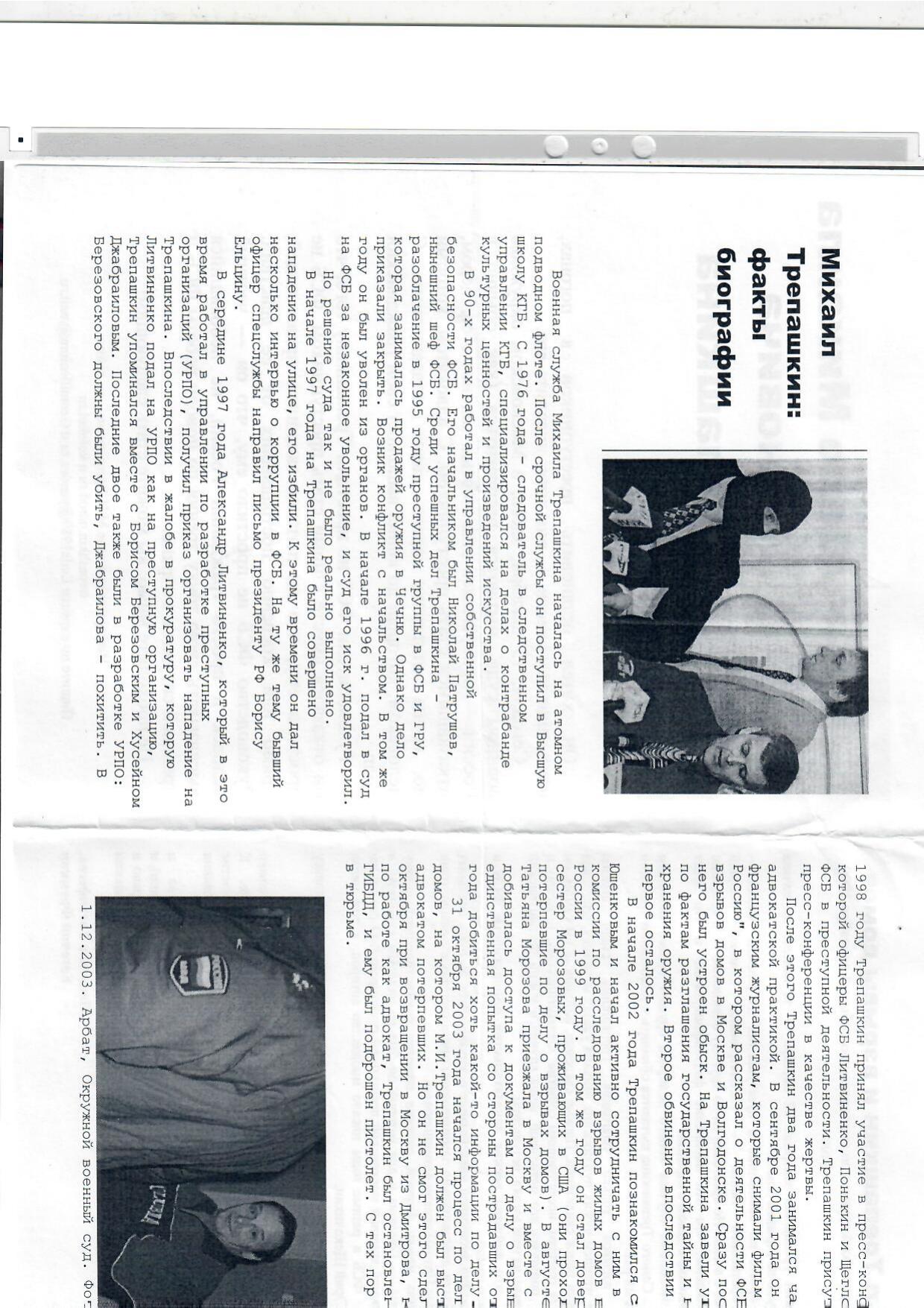
1.12.2003. Арбат, Окружной военный суд. Фото
Mikhail Trepashkin: Biographical Facts
Mikhail Trepashkin's military service began in the nuclear submarine fleet. After his conscript service, he entered the Higher School of the KGB. From 1976, he was an investigator in the KGB's investigative department, specializing in cases involving the smuggling of cultural valuables and works of art.
In the 1990s, he worked in the FSB's Internal Security Directorate. His superior was Nikolai Patrushev, the current head of the FSB. Among Trepashkin's successful cases was the 1995 exposure of a criminal group within the FSB and GRU that was involved in selling weapons to Chechnya. However, the case was ordered closed. A conflict with the leadership arose. In the same year, he was dismissed from the agencies. In early 1996, he sued the FSB for illegal dismissal, and the court granted his claim. But the court's decision was never actually implemented.
In early 1997, Trepashkin was attacked on the street and beaten. By this time, he had given several interviews about corruption in the FSB. On the same topic, the former intelligence officer sent a letter to the President of the Russian Federation, Boris Yeltsin.
In mid-1997, Alexander Litvinenko, who at that time worked in the Directorate for the Development of Criminal Organizations (URPO), received an order to organize an attack on Trepashkin. Subsequently, in a complaint to the prosecutor's office that Litvinenko filed against URPO as a criminal organization, Trepashkin was mentioned along with Boris Berezovsky and Khusein Dzhabrailov. The latter two were also under URPO surveillance: Berezovsky was to be killed, and Dzhabrailov was to be kidnapped. In 1998, Trepashkin took part in a press conference at which FSB officers Litvinenko, Ponkin, and Shchepkin accused the FSB of criminal activity. Trepashkin attended the press conference as a victim.
After this, Trepashkin spent two years in private legal practice. In September 2001, he assisted French journalists who were filming the movie "Assassination of Russia," in which he spoke about FSB activities in connection with the apartment bombings in Moscow and Volgodonsk. Immediately after this, a search was conducted at his home. A criminal case was opened against Trepashkin on charges of disclosing state secrets and illegal possession of weapons. The second charge was later dropped, but the first remained.
In early 2002, Trepashkin met Sergei Yushenkov and began actively cooperating with him in the public commission investigating the apartment bombings in Russian cities in 1999. In the same year, he became the legal representative for the Morozov sisters, who live in the USA (they were recognized as victims in the apartment bombings case). In August 2003, Tatyana Morozova came to Moscow and, together with Trepashkin, sought access to documents on the bombing case. This was the only attempt by victims of the 1999 terrorist attacks to obtain any information on the case.
On October 31, 2003, the trial for the apartment bombings case began, at which M.I. Trepashkin was supposed to appear as a lawyer for the victims. But he was unable to do so. On October 21, while returning to Moscow from Dmitrov while traveling for work as a lawyer, Trepashkin was stopped by GIBDD (traffic police) officers, and a pistol was planted on him. Since then, he has been in prison.
December 1, 2003. Arbat, District Military Court. Photo