Но это обесценивало огромную часть их труда и риска, поэтому такой вариант представляется менее вероятным.
Для Гочияева преждевременные взрывы были особенно опасны: еще не была окончательно вывезена взрывчатка со склада на Краснодарской, снятого на его настоящее имя.
Но то, что, «узнав о взрывах, мы бежали в Чечню», на правду не похоже совершенно. Взрыв дома в Волгодонске 16 сентября, по всем признакам, расследован местными сыщиками вполне аккуратно. Какую-то причастность к этому событию признают в письме и сами подозреваемые. На паническое бегство в Чечню это совсем не похоже.
Перовский след?
Обвиняемые пишут об участии в организации взрывов «известного агента спецслужб» Макса Лазовского. По словам Юрия Фельштинского, после доставки ему письменных показаний Крымшамхалова и Батчаева он отправил им для опознания фотографию Максима Лазовского — одного из персонажей документальной книги Фельштинского и Литвиненко «ФСБ взрывает Россию». Обвиняемые ответили, что точно сказать не могут: нужны другие фотографии. К сожалению, других фотографий найти не удалось.
Независимо от того, откуда обвиняемые узнали фамилию Лазовского (даже если всего лишь из книги), постараемся ответить на два вопроса. Насколько вероятно участие в рассматриваемых событиях людей Лазовского? И как Лазовский может быть связан со спецслужбами?
Максим Юрьевич Лазовский — глава группы, которую на основании судебных решений можно смело называть бандой. Ее легальным прикрытием была нефтеторговая фирма «Ланако». О масштабе торговой деятельности говорит предмет кровавого спора «Ланако» с фирмой «Виктор» в начале 1994 года: речь шла о продаже самолета. Фирма оказывала и «охранные» услуги, точнее — услуги по вымогательству и запугиванию должников: например, в ходе оказания такой услуги фирме «Росмясомолторг» были убиты три охранника банка-должника. («Росмясомолторг» стал знаменит несколькими годами позже, когда заместителем главы этой фирмы побывал недавний премьер-министр кадыровской Чечни Михаил Бабич). Последний суд над людьми Лазовского закончился летом 2002 года, и количество убитых в ходе деятельности «Ланако», своих и чужих, упомянутых на этом суде, перевалило за два десятка.
Базировалась группа в доме 2 по Переведеновскому переулку, недалеко от станции метро «Бауманская». Поскольку название «измайловская преступная группировка» относят к другой группе, лазовцев можно назвать перовской группировкой — по месту жительства руководителя. В криминологической литературе ее называют лазанской — по ресторану «Лазания» на Пятницкой; с 1997 года здание бывшего ресторана принадлежит Альфа-банку.
Кроме коммерческой деятельности, легальной и преступной, сотрудники «Ланако» прославились и другим занятием: взрывами на транспорте.
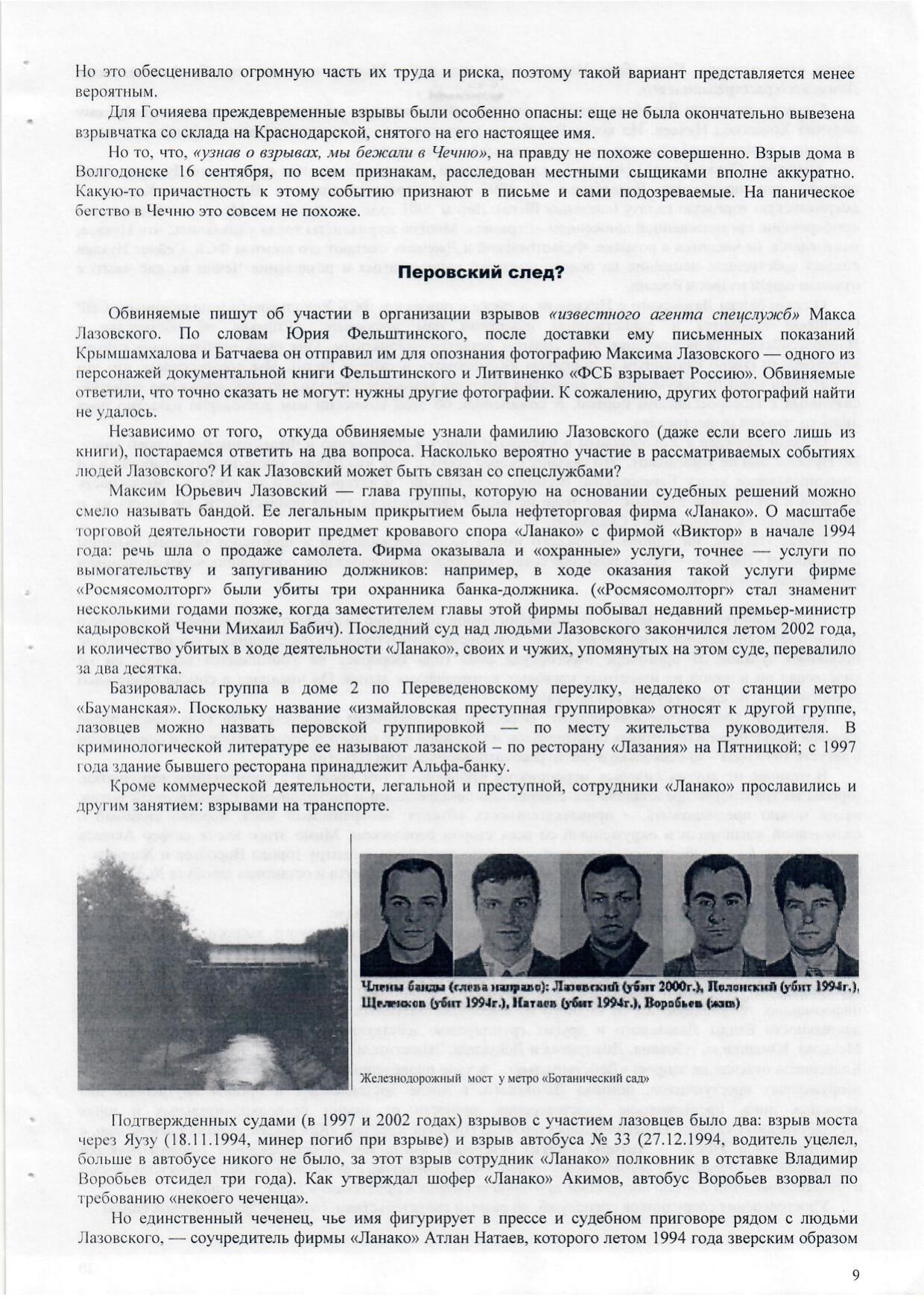
Члены банды (слева направо): Лазовский (убит 2000г.), Полонский (убит 1994г.), Щеленков (убит 1994г.), Натаев (убит 1994г.), Воробьев (жив)
Железнодорожный мост у метро «Ботанический сад»
Подтвержденных судами (в 1997 и 2002 годах) взрывов с участием лазовцев было два: взрыв моста через Яузу (18.11.1994, минер погиб при взрыве) и взрыв автобуса № 33 (27.12.1994, водитель уцелел, больше в автобусе никого не было, за этот взрыв сотрудник «Ланако» полковник в отставке Владимир Воробьев отсидел три года). Как утверждал шофер «Ланако» Акимов, автобус Воробьев взорвал по требованию «некоего чеченца».
Но единственный чеченец, чье имя фигурирует в прессе и судебном приговоре рядом с людьми Лазовского, — соучредитель фирмы «Ланако» Атлан Натаев, которого летом 1994 года зверским образом
But this devalued a huge part of their labor and risk, so such an option seems less likely.
For Gochiyayev, premature explosions were especially dangerous: the explosives had not yet been completely removed from the warehouse on Krasnodarskaya, which was rented in his real name.
But the claim that "having learned about the explosions, we fled to Chechnya" does not look like the truth at all. The bombing of the house in Volgodonsk on September 16, by all indications, was investigated by local detectives quite thoroughly. The suspects themselves admit some involvement in this event in a letter. This does not look like a panic flight to Chechnya at all.
The Perovsky Trace?
The accused write about the participation of a "well-known special services agent" Max Lazovsky in organizing the bombings. According to Yuri Felshtinsky, after receiving the written testimony of Krymshamkhalov and Batchaev, he sent them a photograph of Maxim Lazovsky for identification — one of the characters in Felshtinsky and Litvinenko's documentary book "FSB Blows Up Russia". The accused replied that they could not say for sure: other photographs were needed. Unfortunately, no other photographs could be found.
Regardless of where the accused learned Lazovsky's surname (even if only from the book), let's try to answer two questions. How likely is the participation of Lazovsky's people in the events under consideration? And how might Lazovsky be connected to the special services?
Maxim Yuryevich Lazovsky was the head of a group that, based on court decisions, can boldly be called a gang. Its legal cover was the oil trading firm "Lanako". The scale of its trading activity is indicated by the subject of a bloody dispute between "Lanako" and the firm "Viktor" in early 1994: it concerned the sale of an airplane. The firm also provided "security" services, or more precisely, services for extortion and intimidation of debtors: for example, during the provision of such a service to the firm "Rosmyasomoltorg", three guards of a debtor bank were killed. ("Rosmyasomoltorg" became famous several years later when the recent prime minister of Kadyrov's Chechnya, Mikhail Babich, served as deputy head of this firm). The last trial of Lazovsky's people ended in the summer of 2002, and the number of people killed during "Lanako's" activities, both their own and others, mentioned at this trial, exceeded two dozen.
The group was based at house 2 on Perevedenovsky Lane, near the "Baumanskaya" metro station. Since the name "Izmailovskaya criminal group" refers to another group, Lazovsky's people can be called the Perovskaya group — after the leader's place of residence. In criminological literature, it is called the Lazanskaya group — after the "Lazania" restaurant on Pyatnitskaya; since 1997, the building of the former restaurant has belonged to Alfa-Bank.
In addition to commercial activity, both legal and criminal, "Lanako" employees became famous for another occupation: bombings on transport.
Gang members (from left to right): Lazovsky (killed 2000), Polonsky (killed 1994), Shchelenkov (killed 1994), Nataev (killed 1994), Vorobyov (alive)
Railway bridge near "Botanichesky Sad" metro station
There were two bombings involving Lazovsky's people confirmed by courts (in 1997 and 2002): the bombing of a bridge over the Yauza (11/18/1994, the miner died in the explosion) and the bombing of bus No. 33 (12/27/1994, the driver survived, there was no one else on the bus; for this bombing, "Lanako" employee retired colonel Vladimir Vorobyov served three years). As "Lanako" driver Akimov claimed, Vorobyov blew up the bus at the request of "a certain Chechen".
But the only Chechen whose name appears in the press and the court verdict alongside Lazovsky's people is "Lanako" co-founder Atlan Nataev, who in the summer of 1994 was brutally