Page 10 of 10
ОСМОТР МЕСТ ПРЕСТУПЛЕНИЯ
Изложим события, основываясь в первую очередь на собственной информации, во вторую — на милицейских сообщениях, делавшихся по горячим следам, и лишь за неимением более достоверного — на публикациях со ссылкой на поименованных и безымянных сотрудников прокуратуры и ФСБ.
Улица Краснодарская, 70
Ошибка террориста?
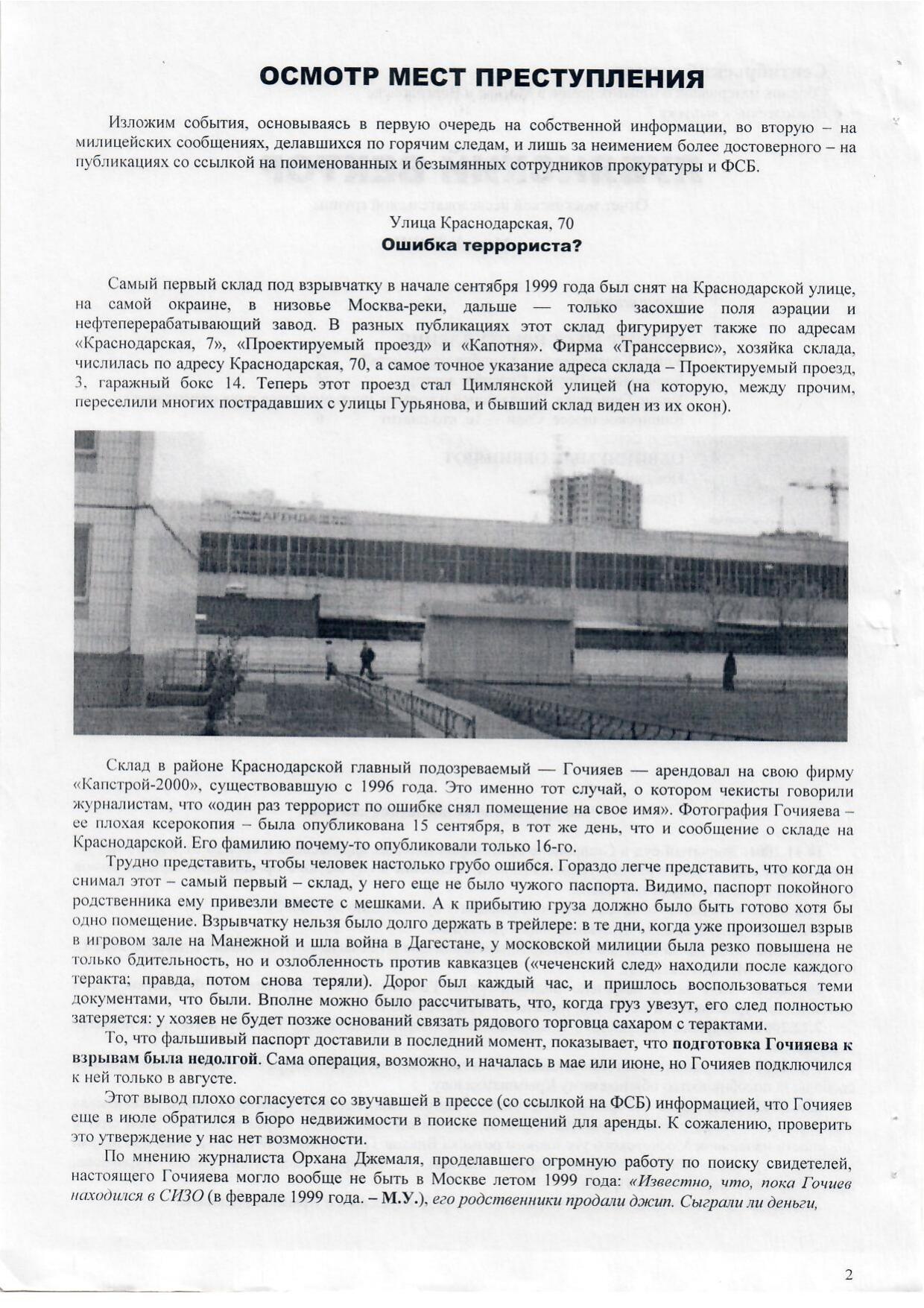
Самый первый склад под взрывчатку в начале сентября 1999 года был снят на Краснодарской улице, на самой окраине, в низовье Москва-реки, дальше — только засохшие поля аэрации и нефтеперерабатывающий завод. В разных публикациях этот склад фигурирует также по адресам «Краснодарская, 7», «Проектируемый проезд» и «Капотня». Фирма «Транссервис», хозяйка склада, числилась по адресу Краснодарская, 70, а самое точное указание адреса склада — Проектируемый проезд, 3, гаражный бокс 14. Теперь этот проезд стал Цимлянской улицей (на которую, между прочим, переселили многих пострадавших с улицы Гурьянова, и бывший склад виден из их окон).
[Фотография многоэтажного жилого дома]
Склад в районе Краснодарской главный подозреваемый — Гочияев — арендовал на свою фирму «Капстрой-2000», существовавшую с 1996 года. Это именно тот случай, о котором чекисты говорили журналистам, что «один раз террорист по ошибке снял помещение на свое имя». Фотография Гочияева — ее плохая ксерокопия — была опубликована 15 сентября, в тот же день, что и сообщение о складе на Краснодарской. Его фамилию почему-то опубликовали только 16-го.
Трудно представить, чтобы человек настолько грубо ошибся. Гораздо легче представить, что когда он снимал этот — самый первый — склад, у него еще не было чужого паспорта. Видимо, паспорт покойного родственника ему привезли вместе с мешками. А к прибытию груза должно было быть готово хотя бы одно помещение. Взрывчатку нельзя было долго держать в трейлере: в те дни, когда уже произошел взрыв в игровом зале на Манежной и шла война в Дагестане, у московской милиции была резко повышена не только бдительность, но и озлобленность против кавказцев («чеченский след» находили после каждого теракта; правда, потом снова теряли). Дорог был каждый час, и пришлось воспользоваться теми документами, что были. Вполне можно было рассчитывать, что, когда груз увезут, его след полностью затеряется: у хозяев не будет позже оснований связать рядового торговца сахаром с терактами.
То, что фальшивый паспорт доставили в последний момент, показывает, что подготовка Гочияева к взрывам была недолгой. Сама операция, возможно, и началась в мае или июне, но Гочияев подключился к ней только в августе.
Этот вывод плохо согласуется со звучавшей в прессе (со ссылкой на ФСБ) информацией, что Гочияев еще в июле обратился в бюро недвижимости в поиске помещений для аренды. К сожалению, проверить это утверждение у нас нет возможности.
По мнению журналиста Орхана Джемаля, проделавшего огромную работу по поиску свидетелей, настоящего Гочияева могло вообще не быть в Москве летом 1999 года: «Известно, что, пока Гочиев находился в СИЗО (в феврале 1999 года. – М.У.), его родственники продали джип. Сыграли ли деньги,
2
INSPECTION OF CRIME SCENES
We will outline the events, based primarily on our own information, secondarily on police reports made in the immediate aftermath, and only for lack of anything more reliable, on publications citing named and unnamed employees of the Prosecutor's Office and the FSB.
70 Krasnodarskaya Street
Terrorist's mistake?
The very first warehouse for explosives in early September 1999 was rented on Krasnodarskaya Street, on the very outskirts, in the lower reaches of the Moskva River; beyond that are only dried-up aeration fields and an oil refinery. In various publications, this warehouse also appears under the addresses "Krasnodarskaya, 7," "Projected Driveway," and "Kapotnya." The firm "Transservice," the owner of the warehouse, was registered at 70 Krasnodarskaya Street, but the most accurate indication of the warehouse address is Projected Driveway 3, garage box 14. Now this driveway has become Tsimlyanskaya Street (to which, by the way, many victims from Guryanova Street were relocated, and the former warehouse is visible from their windows).
[Photograph of a multi-story residential building]
The warehouse in the Krasnodarskaya area was rented by the main suspect — Gochiyayev — for his firm "Kapstroy-2000," which had existed since 1996. This is precisely the case about which the Chekists told journalists that "once, a terrorist mistakenly rented a premises in his own name." A photograph of Gochiyayev — a poor photocopy of it — was published on September 15, the same day as the report about the warehouse on Krasnodarskaya. For some reason, his surname was only published on the 16th.
It is hard to imagine that a person would make such a gross mistake. It is much easier to imagine that when he rented this — the very first — warehouse, he did not yet have someone else's passport. Apparently, the passport of a deceased relative was brought to him along with the sacks. And at least one premises had to be ready for the arrival of the cargo. Explosives could not be kept in a trailer for long: in those days, when the explosion in the Manezhnaya amusement arcade had already occurred and the war in Dagestan was underway, the Moscow police had sharply increased not only their vigilance but also their animosity toward Caucasians (a "Chechen trace" was found after every terrorist attack; though, later it would be lost again). Every hour was precious, and he had to use the documents that were available. It was quite reasonable to expect that once the cargo was moved, its trail would be completely lost: the owners would have no reason later to link an ordinary sugar trader with terrorist attacks.
The fact that the fake passport was delivered at the last moment shows that Gochiyayev's preparation for the bombings was short. The operation itself may have begun in May or June, but Gochiyayev only joined it in August.
This conclusion does not align well with information that appeared in the press (citing the FSB) that Gochiyayev had already approached a real estate bureau in July looking for premises to rent. Unfortunately, we have no way to verify this claim.
According to journalist Orkhan Dzhemal, who did an enormous amount of work searching for witnesses, the real Gochiyayev might not have been in Moscow at all in the summer of 1999: "It is known that while Gochiyayev was in SIZO [remand prison] (in February 1999. – M.U.), his relatives sold a jeep. Whether the money played a role,
2