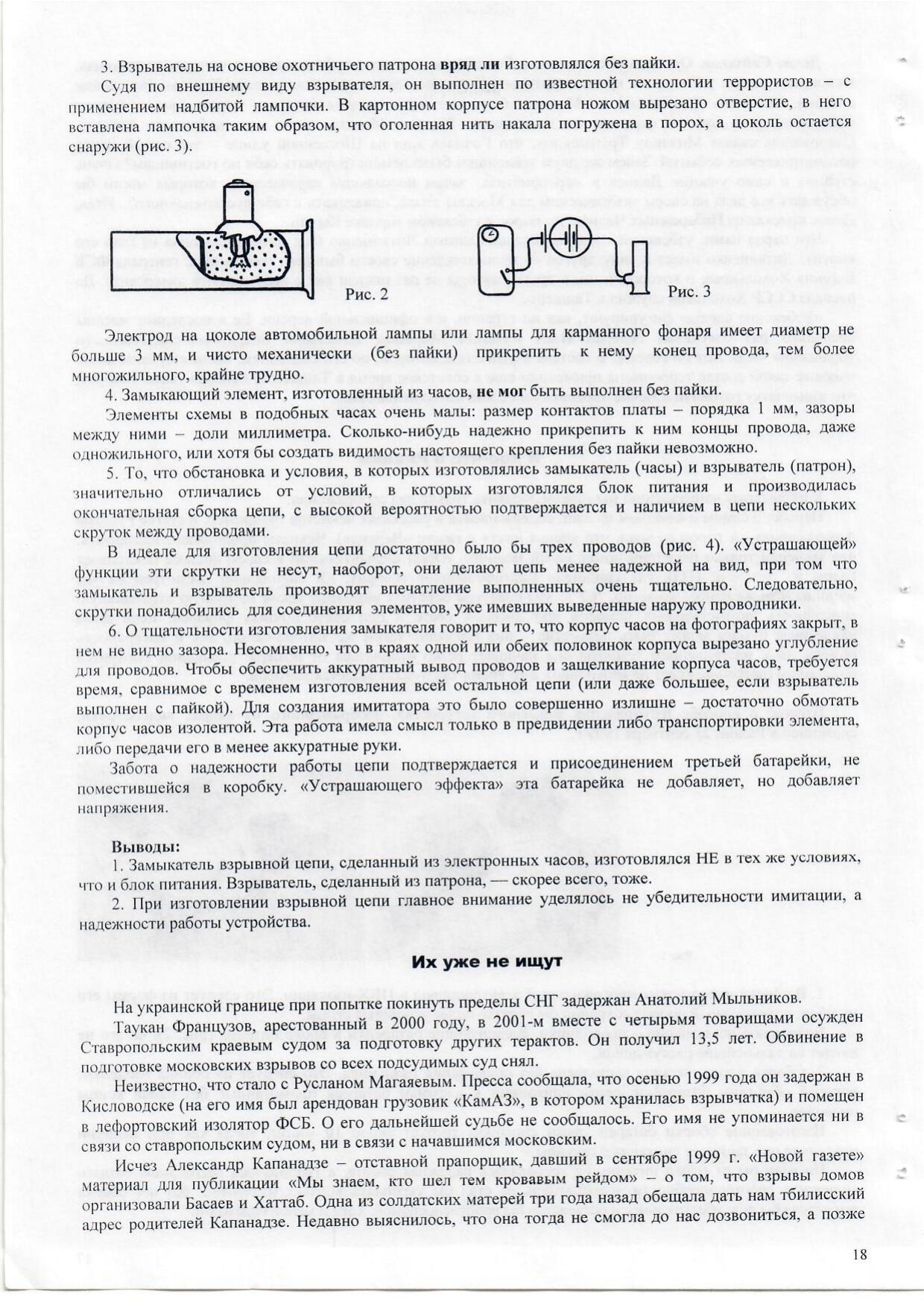
- Взрыватель на основе охотничьего патрона вряд ли изготовлялся без пайки.
Судя по внешнему виду взрывателя, он выполнен по известной технологии террористов — с применением надбитой лампочки. В картонном корпусе патрона ножом вырезано отверстие, в него вставлена лампочка таким образом, что оголенная нить накала погружена в порох, а цоколь остается снаружи (рис. 3).
[Рис. 2, Рис. 3]
Электрод на цоколе автомобильной лампы или лампы для карманного фонаря имеет диаметр не больше 3 мм, и чисто механически (без пайки) прикрепить к нему конец провода, тем более многожильного, крайне трудно. - Замыкающий элемент, изготовленный из часов, не мог быть выполнен без пайки.
Элементы схемы в подобных часах очень малы: размер контактов платы — порядка 1 мм, зазоры между ними — доли миллиметра. Сколько-нибудь надежно прикрепить к ним концы провода, даже одножильного, или хотя бы создать видимость настоящего крепления без пайки невозможно. - То, что обстановка и условия, в которых изготовлялись замыкатель (часы) и взрыватель (патрон), значительно отличались от условий, в которых изготовлялся блок питания и производилась окончательная сборка цепи, с высокой вероятностью подтверждается и наличием в цепи нескольких скруток между проводами.
В идеале для изготовления цепи достаточно было бы трех проводов (рис. 4). «Устрашающей» функции эти скрутки не несут, наоборот, они делают цепь менее надежной на вид, при том что замыкатель и взрыватель производят впечатление выполненных очень тщательно. Следовательно, скрутки понадобились для соединения элементов, уже имевших выведенные наружу проводники. - О тщательности изготовления замыкателя говорит и то, что корпус часов на фотографиях закрыт, в нем не видно зазора. Несомненно, что в краях одной или обеих половинок корпуса вырезано углубление для проводов. Чтобы обеспечить аккуратный вывод проводов и защелкивание корпуса часов, требуется время, сравнимое с временем изготовления всей остальной цепи (или даже большее, если взрыватель выполнен с пайкой). Для создания имитатора это было совершенно излишне — достаточно обмотать корпус часов изолентой. Эта работа имела смысл только в предвидении либо транспортировки элемента, либо передачи его в менее аккуратные руки.
Забота о надежности работы цепи подтверждается и присоединением третьей батарейки, не поместившейся в коробку. «Устрашающего эффекта» эта батарейка не добавляет, но добавляет напряжения.
Выводы:
1. Замыкатель взрывной цепи, сделанный из электронных часов, изготовлялся НЕ в тех же условиях, что и блок питания. Взрыватель, сделанный из патрона, — скорее всего, тоже.
2. При изготовлении взрывной цепи главное внимание уделялось не убедительности имитации, а надежности работы устройства.
Их уже не ищут
На украинской границе при попытке покинуть пределы СНГ задержан Анатолий Мыльников.
Таукан Французов, арестованный в 2000 году, в 2001-м вместе с четырьмя товарищами осужден Ставропольским краевым судом за подготовку других терактов. Он получил 13,5 лет. Обвинение в подготовке московских взрывов со всех подсудимых суд снял.
Неизвестно, что стало с Русланом Магаевым. Пресса сообщала, что осенью 1999 го он задержан в Кисловодске (на его имя был арендован грузовик «КамАЗ», в котором хранилась взрывчатка) и помещен в лефортовский изолятор ФСБ. О его дальнейшей судьбе не сообщалось. Его имя не упоминается ни в связи со ставропольским судом, ни в связи с начавшимся московским.
Исчез Александр Капанадзе — отставной прапорщик, давший в сентябре 1999 г. «Новой газете» материал для публикации «Мы знаем, кто шел тем кровавым рейдом» — о том, что взрывы домов организовали Басаев и Хаттаб. Одна из солдатских матерей три года назад обещала дать нам тбилисский адрес родителей Капанадзе. Недавно выяснилось, что она тогда не смогла до нас дозвониться, а позже...
Analysis of Device Construction
Detonator Construction
- A detonator based on a hunting cartridge was unlikely to have been made without soldering.
- Judging by the appearance of the detonator, it was made according to a well-known terrorist technology—using a cracked lightbulb.
- A hole was cut in the cardboard casing of the cartridge with a knife, and a lightbulb was inserted into it in such a way that the exposed filament was immersed in gunpowder, while the base remained outside (Fig. 3).
Circuit Element Assembly
- The electrode on the base of a car lamp or a flashlight lamp has a diameter of no more than 3 mm, and it is extremely difficult to attach the end of a wire, especially a stranded one, to it purely mechanically (without soldering).
- The closing element, made from a watch, could not have been made without soldering.
- The circuit elements in such watches are very small: the size of the board contacts is about 1 mm, the gaps between them are fractions of a millimeter.
- It is impossible to reliably attach wire ends to them, even single-core ones, or at least create the appearance of a real attachment without soldering.
Assembly Discrepancies
- The fact that the setting and conditions in which the closer (watch) and detonator (cartridge) were made differed significantly from the conditions in which the power supply was made and the final assembly of the circuit was carried out is confirmed with high probability by the presence of several twists between the wires in the circuit.
- Ideally, three wires would have been enough to make the circuit (Fig. 4).
- These twists do not carry an "intimidating" function; on the contrary, they make the circuit look less reliable, while the closer and detonator give the impression of being made very carefully.
- Consequently, the twists were needed to connect elements that already had leads coming out.
Watch Case Construction
- The care taken in making the closer is also evidenced by the fact that the watch case in the photographs is closed, and no gap is visible in it.
- Undoubtedly, a recess for the wires was cut into the edges of one or both halves of the case.
- To ensure a neat lead-out of the wires and the snapping shut of the watch case requires time comparable to the time it takes to make the rest of the circuit (or even more, if the detonator is made with soldering).
- To create a mock-up, this was completely unnecessary—it would have been enough to wrap the watch case with electrical tape.
- This work made sense only in anticipation of either transporting the element or handing it over to less careful hands.
- The concern for the reliability of the circuit's operation is also confirmed by the connection of a third battery that did not fit in the box. This battery does not add to the "intimidating effect," but it does add voltage.
Conclusions
- The explosive circuit closer made from an electronic watch was NOT made in the same conditions as the power supply. The detonator made from a cartridge most likely was not either.
- In the manufacture of the explosive circuit, the main attention was paid not to the persuasiveness of the imitation, but to the reliability of the device's operation.
Other News
- They are no longer being sought
- Anatoly Mylnikov was detained at the Ukrainian border while attempting to leave the CIS.
- Taukan Frantsuzov, arrested in 2000, was sentenced in 2001 along with four comrades by the Stavropol Regional Court for preparing other terrorist acts. He received 13.5 years. The court dropped the charges of preparing the Moscow bombings for all the defendants.
- It is unknown what happened to Ruslan Magayev. The press reported that in the fall of 1999 he was detained in Kislovodsk (a KamAZ truck in which explosives were stored was rented in his name) and placed in the FSB's Lefortovo detention center. No further reports on his fate were made. His name is mentioned neither in connection with the Stavropol trial nor in connection with the Moscow trial that has begun.
- Alexander Kapanadze has disappeared—a retired warrant officer who in September 1999 gave "Novaya Gazeta" material for the publication "We know who went on that bloody raid"—about how the apartment bombings were organized by Basaev and Khattab. One of the soldiers' mothers promised three years ago to give us the Tbilisi address of Kapanadze's parents. It recently turned out that she was unable to reach us by phone then, and later...