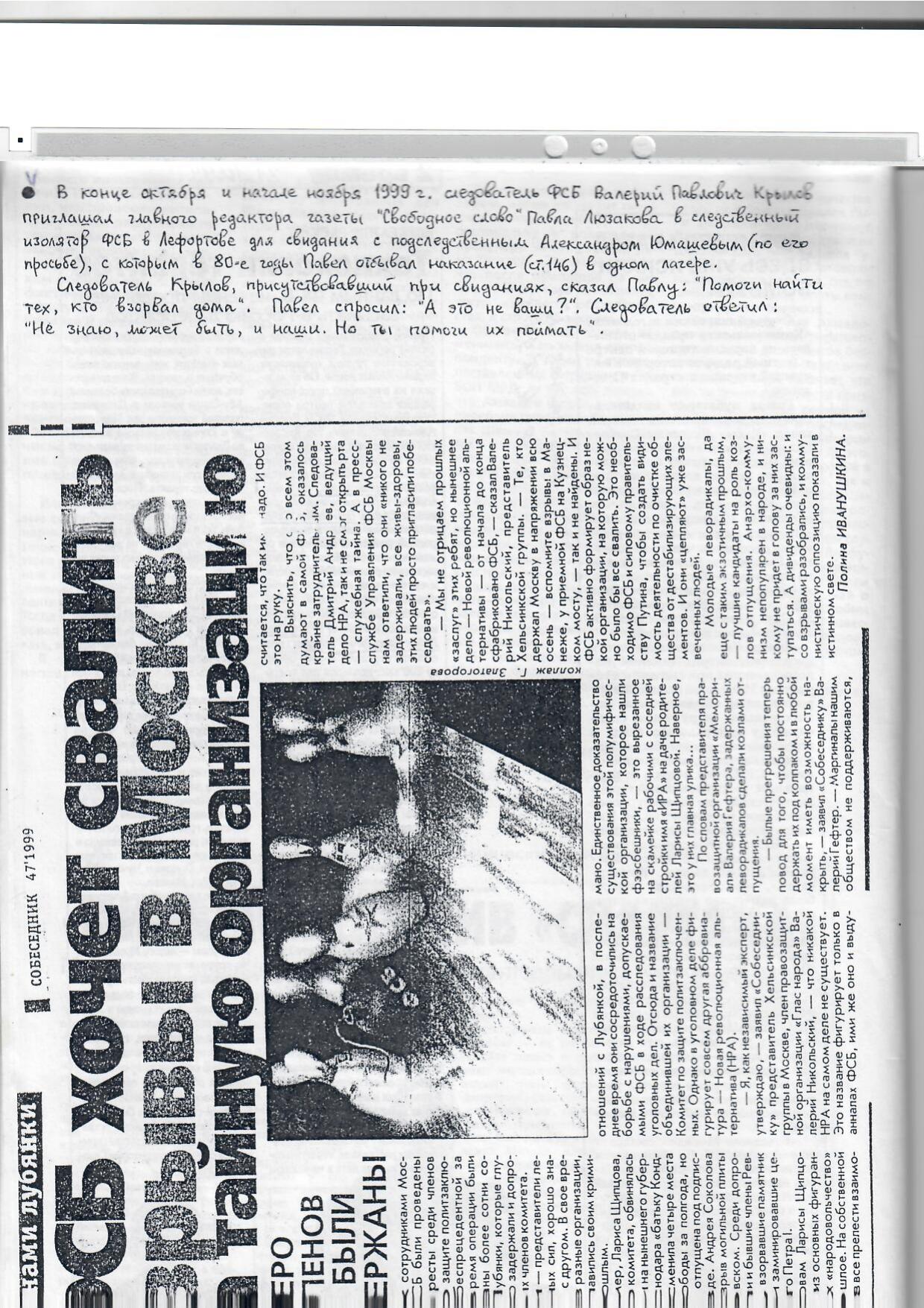
В конце октября и начале ноября 1999 г. следователь ФСБ Валерий Павлович Крылов приглашал главного редактора газеты «Свободное слово» Павла Люзакова в следственный изолятор ФСБ в Лефортове для свидания с подследственным Александром Юмашевым (по его просьбе), с которым в 80-е годы Павел отбывал наказание (ст. 146) в одном лагере. Следователь Крылов, присутствовавший при свиданиях, сказал Павлу: «Помоги найти тех, кто взорвал дома». Павел спросил: «А это не ваши?». Следователь ответил: «Не знаю, может быть, и наши. Но ты помоги их поймать».
ФСБ хочет свалить взрывы в Москве на таинственную организацию
СЕ[МЕ]РО [Ч]ЛЕНОВ БЫЛИ [ЗАД]ЕРЖАНЫ
[...сотрудниками] Мос- [?] были проведены аресты среди членов [?] защите политзаклю- [?] беспрецедентной за время операции были [?] ны более сотни со- [?] Лубянки, которые глу- [?] задержали и допро- [?] их членов комитета.
— представители ле- [?] вых сил, хорошо зна- [?] с другом. В свое вре- [?] в разные организации, [?] лавились своими крими- [?] ошлым.
[...лер], Лариса Щипцова, [?] и комитета, обвинялась [?] ныне нынешнего губер- [?] нодара «батьку Конд- [?] менила четыре места [?] боды за полгода, но [?] отпущена под подпис- [?] де. Андрея Соколова [?] зрыв могильной плиты [?] вском. Среди допро- [?] и бывшие члены «Рев- [?] взорвавшие памятник [?] заминировавшие це- [?] го Петра I.
[...вам] Ларисы Щипцо- [?] из основных фигуран- [?] «народовольчество» [?] шлое. На собственной [?] в все прелести взаимо- отношений с Лубянкой, в последнее время они сосредоточились на борьбе с нарушениями, допускаемыми ФСБ в ходе расследования уголовных дел. Отсюда и название объединившей их организации — Комитет по защите политзаключенных. Однако в уголовном деле фигурирует совсем другая аббревиатура — Новая революционная альтернатива (НРА).
— Я, как независимый эксперт, утверждаю, — заявил «Собеседнику» представитель Хельсинкской группы в Москве, член правозащитной организации «Глас народа» Валерий Никольский, — что никакой НРА на самом деле не существует. Это название фигурирует только в анналах ФСБ, ими же оно и выдумано. Единственное доказательство существования этой полумифической организации, которое нашли фээсбэшники, — это вырезанное на скамейке рабочими с соседней стройки имя «ИРА» на даче родителей Ларисы Щипцовой. Наверное, это у них главная улика...
По словам представителя правозащитной организации «Мемориал» Валерия Гефтера, задержанных леворадикалов сделали козлами отпущения.
— Былые прегрешения теперь повод для того, чтобы постоянно держать их под колпаком и в любой момент иметь возможность накрыть, — заявил «Собеседнику» Валерий Гефтер. — Маргиналы нашим обществом не поддерживаются, считается, что так им и надо. И ФСБ это на руку.
Выяснить, что обо всем этом думают в самой ФСБ, оказалось крайне затруднительным. Следователь Дмитрий Андреев, ведущий дело НРА, так и не смог открыть рта — служебная тайна. А в пресс-службе Управления ФСБ Москвы нам ответили, что они «никого не задерживали, все живы-здоровы, этих людей просто пригласили побеседовать».
— Мы не отрицаем прошлых «заслуг» этих ребят, но нынешнее дело — Новой революционной альтернативы — от начала до конца сфабриковано ФСБ, — сказал Валерий Никольский, представитель Хельсинкской группы. — Те, кто держал Москву в напряжении всю осень — вспомните взрывы в Манеже, у приемной ФСБ на Кузнецком мосту, — так и не найдены. И ФСБ активно формирует образ некой организации, на которую можно было бы все свалить. Это необходимо ФСБ и силовому правительству Путина, чтобы создать видимость деятельности по очистке общества от дестабилизирующих элементов. И они «цепляют» уже засвеченных людей.
Молодые леворадикалы, да еще с таким экзотичным прошлым, — лучшие кандидаты на роль козлов отпущения. Анархо-коммунизм непопулярен в народе, и никому не придет в голову за них заступаться. А дивиденды очевидны: и со взрывами разобрались, и коммунистическую оппозицию показали в истинном свете.
Полина ИВАНУШКИНА.
FSB Wants to Blame the Moscow Bombings on a Mysterious Organization
Interrogation of Pavel Lyuzakov
At the end of October and beginning of November 1999, FSB investigator Valery Pavlovich Krylov invited the editor-in-chief of the newspaper 'Svobodnoye Slovo', Pavel Lyuzakov, to the FSB pre-trial detention center in Lefortovo. The meeting was with the suspect Alexander Yumashev (at his request), with whom Pavel served a sentence (Art. 146) in the same camp in the 80s.
Investigator Krylov, who was present at the meetings, said to Pavel: "Help find those who blew up the houses."
Pavel asked: "And isn't it your people?"
The investigator replied: "I don't know, maybe it's ours. But you help catch them."
Detentions and Accusations
- Seven members were detained among members of the Committee for the Protection of Political Prisoners.
- The arrests were described as "unprecedented during the operation."
- More than a hundred officers from Lubyanka were detained and interrogated.
- The detained individuals included representatives of left-wing forces who were well-acquainted with each other and had known criminal pasts.
Notable Cases
- Larisa Shchipova, a member of the committee, was accused of an attempt on the current governor of Krasnodar, 'Batka Kondratenko'.
- Andrei Sokolov was accused of blowing up a gravestone in Vagankovskoye cemetery.
- Interrogated individuals included former members of the 'Revolutionary Military Council', who were involved in blowing up the monument to Nicholas II and mining the monument to Peter I.
Organizational Names
- Larisa Shchipova mentioned the group's past connection to 'Narodovolchestvo' (People's Will).
- The organization that united them is named the Committee for the Protection of Political Prisoners.
- However, a different abbreviation appears in the criminal case: the New Revolutionary Alternative (NRA).
Expert Opinions on the NRA
Valery Nikolsky, a representative of the Helsinki Group in Moscow and a member of the human rights organization 'Glas Naroda' (Voice of the People), asserted:
"I, as an independent expert, assert, that no NRA actually exists. This name exists only in the annals of the FSB; they invented it themselves. The only evidence of the existence of this semi-mythical organization that the FSB found is the name 'IRA' carved on a bench by workers from a nearby construction site at the dacha of Larisa Shchipova's parents. Apparently, this is their main piece of evidence..."
Valery Gefter, a representative of the human rights organization 'Memorial', stated that the detained left-wing radicals were made scapegoats:
"Past transgressions are now a reason to constantly keep them under surveillance and be able to shut them down at any moment... Marginals are not supported by our society; it is believed they get what they deserve. And this plays into the FSB's hands."
Official Statements and Analysis
- Dmitry Andreev, who is leading the NRA case, could not comment, citing "official secret."
- The Moscow FSB Directorate press service stated that they "did not detain anyone, everyone is alive and well, these people were simply invited for a talk."
Valery Nikolsky further argued:
"We do not deny the past 'merits' of these guys, but the current case — the New Revolutionary Alternative — is fabricated by the FSB from beginning to end... Those who kept Moscow in suspense all autumn — remember the explosions in the Manege, at the FSB reception on Kuznetsky Most — have still not been found. And the FSB is actively forming the image of a certain organization on which everything could be blamed. This is necessary for the FSB and Putin's security-oriented government to create the appearance of activity in cleaning society of destabilizing elements. And they 'hook' people who are already exposed."
Conclusion
The text suggests that young left-wing radicals are the best candidates for scapegoats, as anarcho-communism is unpopular, allowing the bombings to be dealt with while the communist opposition is shown in a negative light.
Polina IVANUSHKINA (Author)