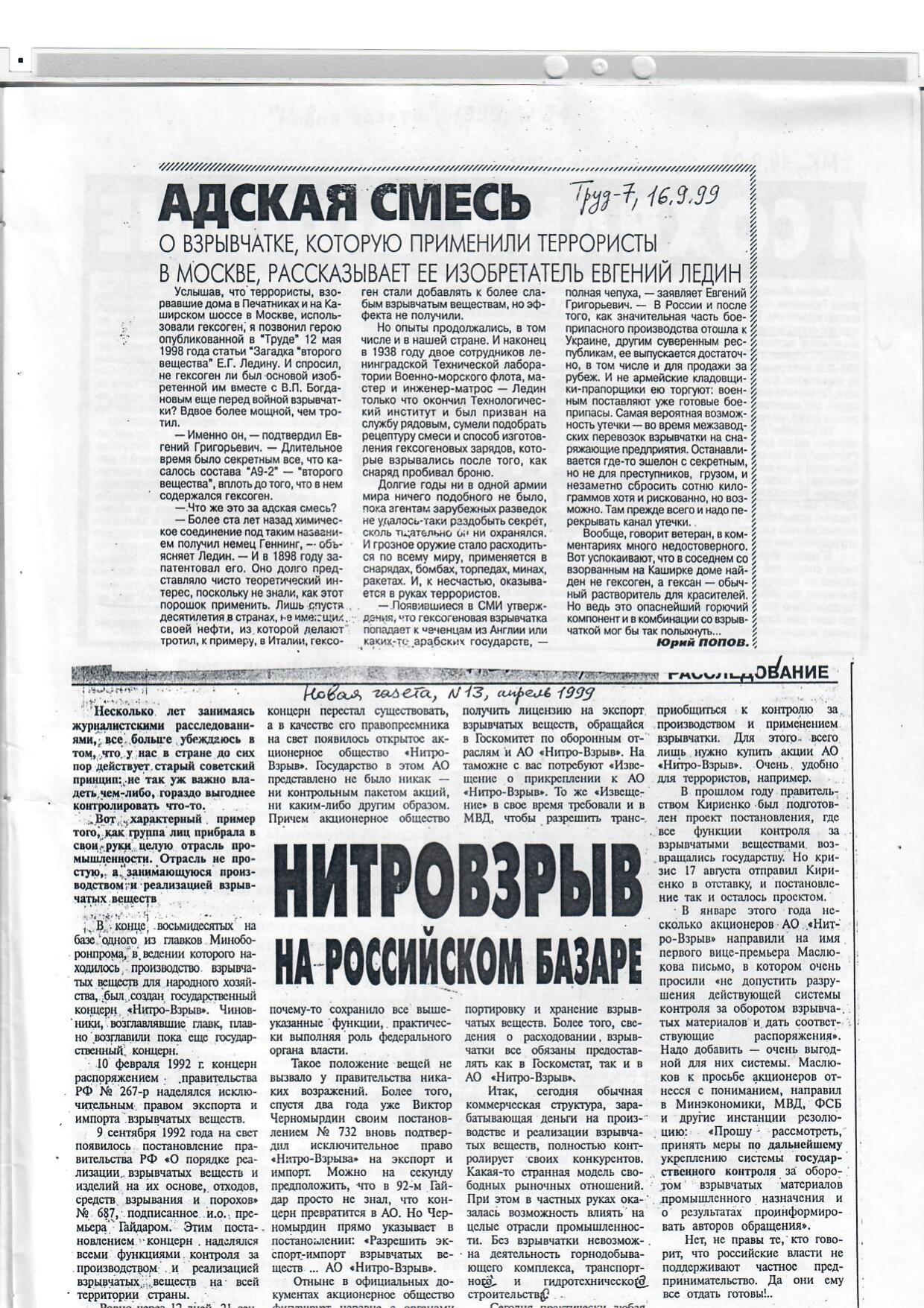
АДСКАЯ СМЕСЬ
Труд-7, 16.9.99
О ВЗРЫВЧАТКЕ, КОТОРУЮ ПРИМЕНИЛИ ТЕРРОРИСТЫ В МОСКВЕ, РАССКАЗЫВАЕТ ЕЕ ИЗОБРЕТАТЕЛЬ ЕВГЕНИЙ ЛЕДИН
Услышав, что террористы, взорвавшие дома в Печатниках и на Каширском шоссе в Москве, использовали гексоген, я позвонил герою опубликованной в "Труде" 12 мая 1998 года статьи "Загадка "второго вещества" Е.Г. Ледину. И спросил, не гексоген ли был основой изобретенной им вместе с В.П. Богдановым еще перед войной взрывчатки? Вдвое более мощной, чем тротил.
— Именно он, — подтвердил Евгений Григорьевич. — Длительное время было секретным все, что касалось состава "А-9-2" — "второго вещества", вплоть до того, что в нем содержался гексоген.
— Что же это за адская смесь?
— Более ста лет назад химическое соединение под таким названием получил немец Геннинг, — объясняет Ледин. — И в 1898 году запатентовал его. Оно долго представляло чисто теоретический интерес, поскольку не знали, как этот порошок применить. Лишь спустя десятилетия в странах, не имеющих своей нефти, из которой делают тротил, к примеру, в Италии, гексоген стали добавлять к более слабым взрывчатым веществам, но эффекта не получили.
Но опыты продолжались, в том числе и в нашей стране. И наконец в 1938 году двое сотрудников ленинградской Технической лаборатории Военно-морского флота, мастер и инженер-матрос — Ледин только что окончил Технологический институт и был призван на службу рядовым, сумели подобрать рецептуру смеси и способ изготовления гексогеновых зарядов, которые взрывались после того, как снаряд пробивал броню.
Долгие годы ни в одной армии мира ничего подобного не было, пока агентам зарубежных разведок не удалось-таки раздобыть секрет, сколь тщательно бы ни охранялся. И грозное оружие стало расходиться по всему миру, применяется в снарядах, бомбах, торпедах, минах, ракетах. И, к несчастью, оказывается в руках террористов.
— Появившиеся в СМИ утверждения, что гексогеновая взрывчатка попадает к чеченцам из Англии или каких-то арабских государств, — полная чепуха, — заявляет Евгений Григорьевич. — В России и после того, как значительная часть боеприпасного производства отошла к Украине, другим суверенным республикам, ее выпускается достаточно, в том числе и для продажи за рубеж. И не армейские кладовщики-прапорщики ею торгуют: военным поставляют уже готовые боеприпасы. Самая вероятная возможность утечки — во время межзаводских перевозок взрывчатки на снаряжающие предприятия. Останавливается где-то эшелон с секретным, но не для преступников, грузом, и незаметно сбросить сотню килограммов хотя и рискованно, но возможно. Там прежде всего и надо перекрывать канал утечки.
Вообще, говорит ветеран, в комментариях много недостоверного. Вот успокаивают, что в соседнем со взорванным на Каширке доме найден не гексоген, а гексан — обычный растворитель для красителей. Но ведь это опаснейший горючий компонент и в комбинации со взрывчаткой мог бы так полыхнуть...
Юрий ПОПОВ.
Новая газета, N 13, апрель 1999
НИТРОВЗРЫВ НА РОССИЙСКОМ БАЗАРЕ
Несколько лет занимаясь журналистскими расследованиями, все больше убеждаюсь в том, что у нас в стране до сих пор действует старый советский принцип: не так уж важно владеть чем-либо, гораздо выгоднее контролировать что-то.
Вот характерный пример того, как группа лиц прибрала в свои руки целую отрасль промышленности. Отрасль не простую, а занимающуюся производством и реализацией взрывчатых веществ.
В конце восьмидесятых на базе одного из главков Миноборонпрома, в ведении которого находилось производство взрывчатых веществ для народного хозяйства, был создан государственный концерн «Нитро-Взрыв». Чиновники, возглавлявшие главк, плавно возглавили пока еще государственный концерн.
10 февраля 1992 г. концерн распоряжением правительства РФ № 267-р наделялся исключительным правом экспорта и импорта взрывчатых веществ.
9 сентября 1992 года на свет появилось постановление правительства РФ «О порядке реализации взрывчатых веществ и изделий на их основе, отходов, средств взрывания и порохов» № 687, подписанное и.о. премьера Гайдаром. Этим постановлением концерн наделялся всеми функциями контроля за производством и реализацией взрывчатых веществ на всей территории страны.
Вскоре концерн перестал существовать, а в качестве его правопреемника на свет появилось открытое акционерное общество «Нитро-Взрыв». В этом АО представлено не было никак — ни контрольным пакетом акций, ни каким-либо другим образом. Причем акционерное общество почему-то сохранило все вышеуказанные функции, практически выполняя роль федерального органа власти.
Такое положение вещей не вызвало у правительства никаких возражений. Более того, спустя два года уже Виктор Черномырдин своим постановлением № 732 вновь подтвердил исключительное право «Нитро-Взрыв» на экспорт и импорт. Можно на секунду предположить, что в 92-м Гайдар просто не знал, что концерн превратится в АО. Но Черномырдин прямо указывает в постановлении: «Разрешить экспорт-импорт взрывчатых веществ... АО «Нитро-Взрыв».
Отныне в официальных документах акционерное общество фигурирует как организация, имеющая право выдавать лицензии на экспорт взрывчатых веществ. Хочешь получить лицензию на экспорт взрывчатых веществ, обращайся в Госкомитет по оборонным отраслям и АО «Нитро-Взрыв». На таможне с вас потребуют «Извещение о прикреплении к АО «Нитро-Взрыв». То же «Извещение» в свое время требовали и в МВД, чтобы разрешить транспортировку и хранение взрывчатых веществ. Более того, сведения о расходовании взрывчатки все обязаны представлять как в Госкомстат, так и в АО «Нитро-Взрыв».
Итак, сегодня обычная коммерческая структура, зарабатывающая деньги на производстве и реализации взрывчатых веществ, полностью контролирует своих конкурентов. Какая-то странная модель свободных рыночных отношений. При этом в частных руках оказалась возможность влиять на целые отрасли промышленности. Без взрывчатки невозможно деятельность горнодобывающего комплекса, транспортного и гидротехнического строительства.
Но самое главное — АО «Нитро-Взрыв» получило возможность приобщиться к контролю за производством и применением взрывчатки. Для этого всего лишь нужно купить акции АО «Нитро-Взрыв». Очень удобно для террористов, например.
В прошлом году правительством Кириенко был подготовлен проект постановления, где все функции контроля за взрывчатыми веществами возвращались государству. Но кризис 17 августа отправил Кириенко в отставку, и постановление так и осталось проектом.
В январе этого года несколько акционеров АО «Нитро-Взрыв» направили на имя первого вице-премьера Маслюкова письмо, в котором очень просили «не допустить разрушения действующей системы контроля за оборотом взрывчатых материалов и дать соответствующие распоряжения». Надо добавить — очень выгодной для них системы. Маслюков к просьбе акционеров отнесся с пониманием, направил в Минэкономики, МВД, ФСБ и другие инстанции резолюцию: «Прошу рассмотреть, принять меры по дальнейшему укреплению системы государственного контроля за оборотом взрывчатых материалов промышленного назначения и о результатах проинформировать авторов обращения».
Нет, не правы те, кто говорит, что российские власти не поддерживают частное предпринимательство. Да они ему все отдать готовы!..
HELLISH MIX
Trud-7, 16.09.99
Inventor's Account: The Mystery of the 'Second Substance'
After hearing that terrorists who blew up houses in Pechatniki and on Kashirskoye Highway in Moscow used hexogen, I contacted E.G. Ledin, the inventor featured in the article "The Mystery of the 'Second Substance'" published in Trud on May 12, 1998. I asked if hexogen was the basis of the explosive he invented with V.P. Bogdanov even before the war, noting it was twice as powerful as TNT.
Evgeny Grigoryevich confirmed:
"Exactly that. For a long time, everything concerning the composition of 'A-9-2' — the 'second substance' — was secret, right down to the fact that it contained hexogen."
When asked, "What kind of hellish mix is this?" Ledin explained:
"More than a hundred years ago, a German named Henning obtained a chemical compound under this name, and in 1898 he patented it. For a long time it was of purely theoretical interest, because they did not know how to apply this powder. Only decades later, in countries that do not have their own oil from which TNT is made, for example, in Italy, hexogen began to be added to weaker explosives, but they did not get the effect."
Development and Spread
- Experiments continued in the Soviet Union.
- In 1938, two employees of the Leningrad Technical Laboratory of the Navy—a master and an engineer-sailor (Ledin had just graduated from the Technological Institute and was called up as a private)—managed to select the recipe and manufacturing method for hexogen charges that exploded after the shell pierced armor.
- For many years, no army in the world possessed this, until foreign intelligence agents obtained the secret.
- The formidable weapon spread globally, used in:
- Shells
- Bombs
- Torpedoes
- Mines
- Rockets
- Unfortunately, it ended up in the hands of terrorists.
On the Leakage of Explosives
Evgeny Grigoryevich refuted media claims regarding the source of hexogen explosives reaching the Chechens from England or Arab states:
"In Russia, even after a significant part of ammunition production went to Ukraine and other sovereign republics, enough of it is produced, including for sale abroad. And it's not army warehouse warrant officers who trade it: the military is supplied with ready-made ammunition. The most likely possibility of a leak is during inter-plant transport of explosives to filling enterprises. An echelon with a secret cargo—but not secret to criminals—stops somewhere, and it is possible, though risky, to unnoticedly drop off a hundred kilograms. That is where the leak channel must be closed first and foremost."
The veteran also dismissed other media reports, such as the claim that hexane (an ordinary dye solvent) was found near the blast site on Kashirka, emphasizing that hexogen is a far more dangerous combustible component.
Source: Yuri Popov, Novaya Gazeta, No. 13, April 1999**
NITRO-EXPLOSION ON THE RUSSIAN MARKET
After years of journalistic investigation, I am convinced that the old Soviet principle persists in our country: it is not so important to own something, it is much more profitable to control something.
A prime example is how a group of individuals took over an entire industry—the production and sale of explosives.
The Rise of Control
- Late Eighties: The state concern "Nitro-Vzryv" was created based on one of the main directorates (glavks) of the Ministry of Defense Industry, which managed explosives production for the national economy. The officials leading the glavk smoothly took charge of the state concern.
- February 10, 1992: By Government Decree of the Russian Federation No. 267-r, the concern was granted the exclusive right to export and import explosives.
- September 9, 1992: Government Decree of the Russian Federation No. 687 (signed by acting Prime Minister Gaidar) endowed the concern with all functions of control over the production and sale of explosives throughout the country.
- Transition to JSC: The concern soon ceased to exist, replaced by the open joint-stock company (OAO) "Nitro-Vzryv." The state held no stake in this JSC. Despite this, the JSC retained all the aforementioned functions, effectively acting as a federal government body.
- Confirmation of Monopoly: Two years later, Viktor Chernomyrdin, with Decree No. 732, reaffirmed "Nitro-Vzryv's" exclusive right to export and import.
The Mechanism of Control
From that point on, official documents showed the JSC as the entity authorized to issue licenses for explosive exports. To export, one needed to contact both the State Committee for Defense Industries and JSC "Nitro-Vzryv." Customs required a "Notice of Attachment to JSC 'Nitro-Vzryv'," a notice previously required by the Ministry of Internal Affairs for transporting and storing explosives. Furthermore, all entities were obliged to report explosive consumption to both Goskomstat and JSC "Nitro-Vzryv."
This resulted in an ordinary commercial structure profiting from explosives production and sales gaining complete control over its competitors—a strange model of free market relations where the possibility of influencing entire industries ended up in private hands. Since mining, transport, and hydraulic engineering construction depend on explosives, this control is immense.
Crucially, JSC "Nitro-Vzryv" gained the opportunity to participate in the control over the production and use of explosives, simply by buying shares. This is highly convenient for terrorists.
Attempts at Reversal
- Last year, the Kirienko government prepared a draft decree to return all control functions to the state, but the August 17 crisis forced Kirienko into resignation, leaving the decree as a draft.
- In January of this year, several shareholders of JSC "Nitro-Vzryv" petitioned First Deputy Prime Minister Maslyukov, strongly requesting "not to allow the destruction of the current system of control over the circulation of explosive materials and to give appropriate orders."
- Maslyukov responded by sending a resolution to the Ministry of Economy, the Ministry of Internal Affairs, the FSB, and other bodies, asking them to "consider, take measures to further strengthen the system of state control over the circulation of industrial explosive materials."
The author concludes that those claiming Russian authorities do not support private enterprise are mistaken; they are, in fact, ready to give everything to it.