ПРЕЦЕДЕНТ
Первый террорист?
Абсолютно закрытый ход не только следствия, но и суда заставляет сомневаться в том, что это дело — первый успех в борьбе с терроризмом в столице.
К странным обстоятельствам этой истории «МН» обращались дважды (№ 24 за 1997 и № 42 за 1998 год). Напомним, что 27 декабря 1994 года, то есть в самом начале чеченской войны, на конечной остановке маршрута № 33 близ ВДНХ шашкой аммонита был подорван пустой автобус. Водитель отделался легким испугом, больше никто не пострадал. Лишь в августе 1996 года, то есть вскоре после взрывов двух троллейбусов в Москве, был арестован главный подозреваемый — Владимир В.
В. был к тому времени подполковником в отставке, занимавшимся мелким бизнесом, а ранее преподававшим (он кандидат технических наук) в академии. В 1997 году (видимо, с подачи следствия, так как из других источников узнать эту информацию было вряд ли возможно) о близком раскрытии «теракта» рассказала газета «Московский комсомолец». В качестве доказательства виновности В. в заметке, в частности, сообщалось, что он... «будучи студентом военного училища, ради забавы смастерил взрывпакет и пытался выбросить его из окна общежития»...
На В. как сообщника по взрыву автобуса указал его знакомый по бизнесу Акимов, который ранее был арестован по совершенно другому делу, и дал «явку с повинной» в условиях лишения свободы. Акимов направлялся на психиатрическую экспертизу и неоднократно менял показания. Он сообщил, что автобус был взорван по заданию некоего чеченца, однако, насколько нам известно, «заказчик» теракта перед судом так и не предстал. Вообще из-за закрытого характера суда мы до сих пор не знаем, были ли представлены суду какие-то более весомые доказательства вины террориста.
Тем не менее приговор вынесен. Судья, фамилию которого в канцелярии Мосгорсуда нам назвать отказались, приговорил В. к трем годам лишения свободы, хотя статья кодекса, устанавливающая ответственность за терроризм, указывает в качестве санкции срок от 5 до 10 лет. Однако как раз три года террорист к этому моменту уже находился в предварительном заключении, поэтому из зала суда он был освобожден. Сестра Владимира В. сообщила нам, что ее брат находится в тяжелом психическом состоянии и ни с кем из журналистов встречаться не хочет.
По словам государственного обвинителя на этом процессе, представителя Московской городской прокуратуры Нины Барковой, она потребовала именно трех лет лишения свободы, учитывая, что В. ранее был не судим, имеет детей, по службе характеризуется положительно. Остальные подробности дела она отказалась назвать, сославшись на секретность.
Другой сотрудник московской прокуратуры Виктор Лютиков сказал в беседе с корреспондентом «МН»: «Странно, что судьи и прокуроры скрывают подробности этого дела. Впрочем, по закону, они не обязаны рассказывать публике все обстоятельства процесса, по которому уже вынесен приговор. А что касается предельно малого срока за терроризм, то я был государственным обвинителем по делу психически больных супругов, которые угрожали взорвать гостиницу «Центральная». Терроризм налицо, но я потребовал только один год заключения для мужчины».
Из-за многочисленных странностей и секретности этого дела мы лишены возможности оценить профессионализм как следствия, так и его оперативного сопровождения. По этим же причинам трудно судить о перспективах раскрытия и расследования новых, только что совершенных в Москве террористических актов, которые повлекли уже куда более трагические последствия.
Дмитрий БАЛЬБУРОВ,
Леонид НИКИТИНСКИЙ
МОСКОВСКИЕ НОВОСТИ N 35, 1999
В августе Мосгорсуд вынес приговор по акту террора, который был совершен в декабре 1994 года.
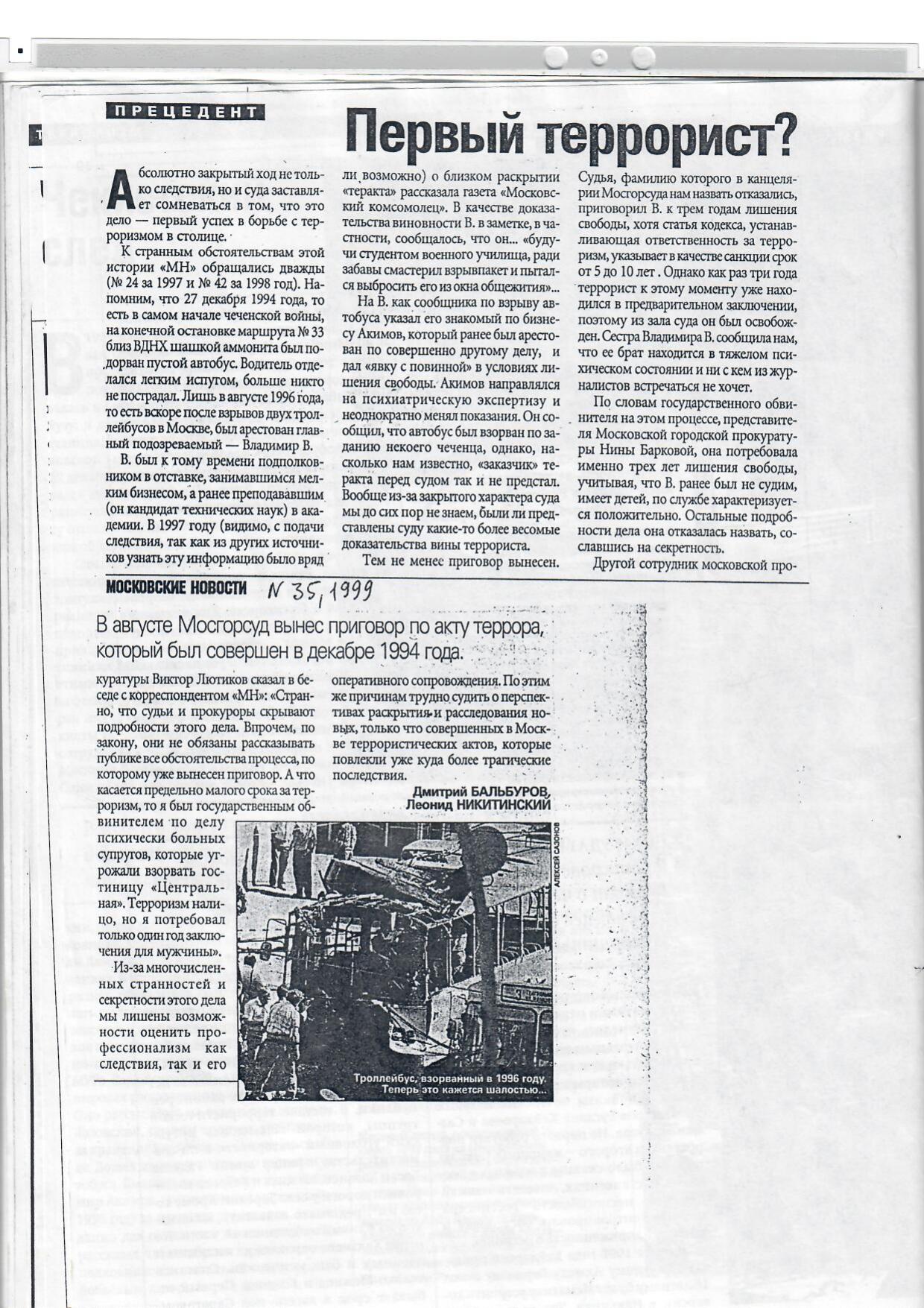
[Подпись к фото:] Троллейбус, взорванный в 1996 году. Теперь это кажется шалостью...
Precedent: The First Terrorist?
The absolutely closed nature of not only the investigation but also the trial makes one doubt that this case is the first success in the fight against terrorism in the capital.
"MN" has addressed the strange circumstances of this story twice (No. 24 for 1997 and No. 42 for 1998).
Background of the Incident
- On December 27, 1994, at the very beginning of the Chechen war, an empty bus was blown up with an ammonite stick at the final stop of Route No. 33 near VDNKh.
- The driver escaped with a slight scare; no one else was hurt.
- The main suspect, Vladimir V., was arrested only in August 1996, shortly after the explosions of two trolleybuses in Moscow.
The Suspect and Evidence
By that time, V. was a retired lieutenant colonel engaged in small business, who had previously taught (he is a Candidate of Technical Sciences) at the academy.
- In 1997, the newspaper "Moskovsky Komsomolets" reported on the imminent solving of the "terrorist attack" (apparently at the suggestion of the investigation).
- As evidence of V.'s guilt, the article reported that he:
- "...while a student at a military school, made a firecracker for fun and tried to throw it out of the dormitory window..."
V. was identified as an accomplice in the bus bombing by his business acquaintance Akimov.
- Akimov had previously been arrested in a completely different case and gave a "voluntary confession" while in custody.
- Akimov was being sent for a psychiatric evaluation and repeatedly changed his testimony.
- Akimov reported that the bus was blown up on the orders of a certain Chechen; however, the "customer" of the terrorist attack never appeared before the court.
In general, due to the closed nature of the trial, it remains unknown whether any more weightier evidence of the terrorist's guilt was presented to the court.
The Verdict and Proceedings
A sentence was passed:
- The judge, whose surname the Moscow City Court office refused to give, sentenced V. to three years of imprisonment.
- This sentence was notable because the article of the code establishing responsibility for terrorism specifies a term of 5 to 10 years as a sanction.
- However, the terrorist had already been in pretrial detention for exactly three years by that point, so he was released from the courtroom.
- Vladimir V.'s sister stated that her brother is in a serious psychological state and does not want to meet with any journalists.
Official Statements
- Nina Barkova, the state prosecutor in this trial (a representative of the Moscow City Prosecutor's Office), requested exactly three years of imprisonment, citing that V. had no prior convictions, has children, and is characterized positively in his service. She refused to name other details of the case, citing secrecy.
- Viktor Lyutikov, another employee of the Moscow prosecutor's office, stated in a conversation with an "MN" correspondent:
> "It is strange that judges and prosecutors hide the details of this case. However, by law, they are not obliged to tell the public all the circumstances of a trial in which a sentence has already been passed. As for the extremely short term for terrorism, I was the state prosecutor in the case of a mentally ill couple who threatened to blow up the 'Tsentralnaya' hotel. Terrorism was evident, but I requested only one year of imprisonment for the man."
Conclusion
Due to the numerous oddities and the secrecy of this case, the ability to evaluate the professionalism of both the investigation and its operational support is limited. For the same reasons, it is difficult to judge the prospects for solving and investigating the new terrorist acts just committed in Moscow, which have already led to far more tragic consequences.
Dmitry BALBUROV,
Leonid NIKITINSKY
MOSCOW NEWS No. 35, 1999
In August, the Moscow City Court delivered a verdict on an act of terror committed in December 1994.
[Photo caption:] A trolleybus blown up in 1996. Now it seems like a prank...