Мир за неделю, № 2, 4-11.9.99
Москву трясет от взрывов
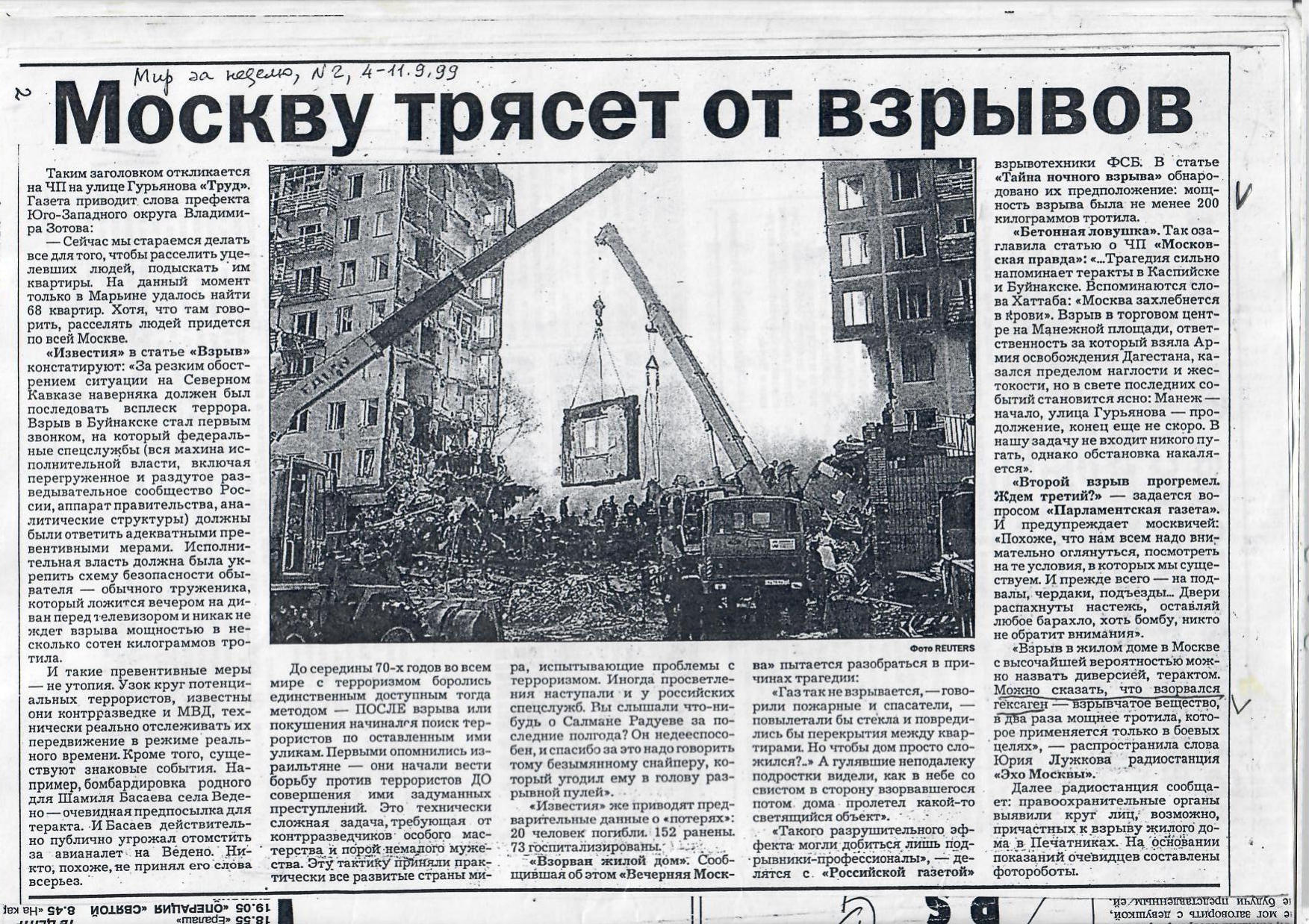
Таким заголовком откликается на ЧП на улице Гурьянова «Труд». Газета приводит слова префекта Юго-Западного округа Владимира Зотова:
— Сейчас мы стараемся делать все для того, чтобы расселить уцелевших людей, подыскать им квартиры. На данный момент только в Марьине удалось найти 68 квартир. Хотя, что там говорить, расселять людей придется по всей Москве.
«Известия» в статье «Взрыв» констатируют: «За резким обострением ситуации на Северном Кавказе наверняка должен был последовать всплеск террора. Взрыв в Буйнакске стал первым звонком, на который федеральные спецслужбы (вся махина исполнительной власти, включая перегруженное и раздутое разведывательное сообщество России, аппарат правительства, аналитические структуры) должны были ответить адекватными превентивными мерами. Исполнительная власть должна была укрепить схему безопасности обывателя — обычного труженика, который ложится вечером на диван перед телевизором и никак не ждет взрыва мощностью в несколько сотен килограммов тротила.
И такие превентивные меры — не утопия. Узок круг потенциальных террористов, известны они контрразведке и МВД, технически реально отслеживать их передвижение в режиме реального времени. Кроме того, существуют знаковые события. Например, бомбардировка родного для Шамиля Басаева села Ведено — очевидная предпосылка для теракта. И Басаев действительно публично угрожал отомстить за авианалет на Ведено. Никто, похоже, не принял его слова всерьез.
До середины 70-х годов во всем мире с терроризмом боролись единственным доступным тогда методом — ПОСЛЕ взрыва или покушения начинался поиск террористов по оставленным ими уликам. Первыми опомнились израильтяне — они начали вести борьбу против террористов ДО совершения ими задуманных преступлений. Это технически сложная задача, требующая от контрразведчиков особого мастерства и порой немалого мужества. Эту тактику приняли практически все развитые страны мира, испытывающие проблемы с терроризмом. Иногда просветления наступали и у российских спецслужб. Вы слышали что-нибудь о Салмане Радуеве за последние полгода? Он недееспособен, и спасибо за это надо говорить тому безымянному снайперу, который угодил ему в голову разрывной пулей».
«Известия» же приводят предварительные данные о «потерях»: 20 человек погибли. 152 ранены. 73 госпитализированы.
«Взорван жилой дом»: Сообщившая об этом «Вечерняя Москва» пытается разобраться в причинах трагедии:
«Газ так не взрывается, — говорили пожарные и спасатели, — повылетали бы стекла и повредились бы перекрытия между квартирами. Но чтобы дом просто сложился?..» А гулявшие неподалеку подростки видели, как в небе со свистом в сторону взорвавшегося потом дома пролетел какой-то светящийся объект».
«Такого разрушительного эффекта могли добиться лишь подрывники-профессионалы», — делятся с «Российской газетой» взрывотехники ФСБ. В статье «Тайна ночного взрыва» обнародовано их предположение: мощность взрыва была не менее 200 килограммов тротила.
«Бетонная ловушка». Так озаглавила статью о ЧП «Московская правда»: «...Трагедия сильно напоминает теракты в Каспийске и Буйнакске. Вспоминаются слова Хаттаба: «Москва захлебнется в крови». Взрыв в торговом центре на Манежной площади, ответственность за который взяла Армия освобождения Дагестана, казался пределом наглости и жестокости, но в свете последних событий становится ясно: Манеж — начало, улица Гурьянова — продолжение, конец еще не скоро. В нашу задачу не входит никого пугать, однако обстановка накаляется».
«Второй взрыв прогремел. Ждем третий?» — задается вопросом «Парламентская газета». И предупреждает москвичей: «Похоже, что нам всем надо внимательно оглянуться, посмотреть на те условия, в которых мы существуем. И прежде всего — на подвалы, чердаки, подъезды... Двери распахнуты настежь, оставляй любое барахло, хоть бомбу, никто не обратит внимания».
«Взрыв в жилом доме в Москве с высочайшей вероятностью можно назвать диверсией, терактом. Можно сказать, что взорвался гексаген — взрывчатое вещество, которое в два раза мощнее тротила, которое применяется только в боевых целях», — распространила слова Юрия Лужкова радиостанция «Эхо Москвы».
Далее радиостанция сообщает: правоохранительные органы выявили круг лиц, возможно, причастных к взрыву жилого дома в Печатниках. На основании показаний очевидцев составлены фотороботы.
World in a Week, No. 2, 4-11.9.99
Moscow is Shaken by Explosions
The headline, "Trud," responds to the emergency on Guryanova Street. The newspaper quotes the prefect of the South-Western District, Vladimir Zotov:
"Now we are trying to do everything to resettle the survivors and find apartments for them. At the moment, 68 apartments have been found in Maryino alone. Although, truth be told, people will have to be resettled all over Moscow."
Analysis from "Izvestia"
In the article "Explosion," "Izvestia" states:
"The sharp aggravation of the situation in the North Caucasus was bound to be followed by a surge of terror. The explosion in Buynaksk was the first warning bell, to which the federal special services (the entire machine of the executive branch, including Russia's overloaded and bloated intelligence community, the government apparatus, and analytical structures) should have responded with adequate preventive measures. The executive branch should have strengthened the security scheme for the common man—the ordinary worker who lies down on the sofa in front of the TV in the evening and in no way expects an explosion with a power of several hundred kilograms of TNT.
And such preventive measures are not a utopia. The circle of potential terrorists is narrow; they are known to counterintelligence and the Ministry of Internal Affairs, and it is technically feasible to track their movement in real time. In addition, there are landmark events. For example, the bombing of Shamil Basaev's native village of Vedeno was an obvious prerequisite for a terrorist attack. And Basaev indeed publicly threatened to take revenge for the air raid on Vedeno. No one, it seems, took his words seriously.
Until the mid-70s, the whole world fought terrorism with the only method available then—AFTER an explosion or assassination attempt, the search for terrorists began based on the clues they left behind. The Israelis were the first to come to their senses—they began to fight terrorists BEFORE they committed their planned crimes. This is a technically difficult task, requiring special skill and sometimes considerable courage from counterintelligence officers. This tactic was adopted by almost all developed countries of the world experiencing problems with terrorism. Sometimes enlightenment also came to the Russian special services. Have you heard anything about Salman Raduyev in the last six months? He is incapacitated, and thanks for this should be given to that anonymous sniper who hit him in the head with an explosive bullet."
"Izvestia" provides preliminary data on "losses":
* Deaths: 20 people
* Wounded: 152
* Hospitalized: 73
Residential Building Blown Up: Investigating the Cause
"Vechernyaya Moskva" reports on the tragedy, attempting to understand the causes:
"Gas doesn't explode like that," said firefighters and rescuers, "windows would have blown out and the floors between apartments would have been damaged. But for the house to just fold up?.." And teenagers walking nearby saw some kind of glowing object fly through the sky with a whistle toward the house that later exploded."
FSB explosives experts share with "Rossiyskaya Gazeta" that:
"Only professional demolitionists could have achieved such a destructive effect."
In the article "Mystery of the Night Explosion," their assumption was made public: the power of the explosion was at least 200 kilograms of TNT.
Media Reactions and Warnings
-
"Moskovskaya Pravda" headlined its article as "Concrete Trap":
> "...The tragedy strongly resembles the terrorist attacks in Kaspiysk and Buynaksk. The words of Khattab come to mind: 'Moscow will choke in blood.' The explosion in the shopping center on Manezh Square, for which the Dagestan Liberation Army claimed responsibility, seemed the limit of audacity and cruelty, but in light of recent events it becomes clear: Manezh was the beginning, Guryanova Street is the continuation, the end is not soon. It is not our task to frighten anyone, but the situation is heating up." -
"Parlamentskaya Gazeta" asks: "The second explosion has thundered. Are we waiting for a third?" and warns Muscovites:
> "It seems that we all need to look around carefully, look at the conditions in which we exist. And first of all—at basements, attics, entrances... The doors are wide open, leave any junk, even a bomb, no one will pay attention." -
"Ekho Moskvy" radio station distributed the words of Yuri Luzhkov:
> "The explosion in a residential building in Moscow can with the highest probability be called sabotage, a terrorist attack. It can be said that hexogen exploded—an explosive substance that is twice as powerful as TNT, which is used only for combat purposes."
Law Enforcement Follow-up
The radio station further reports that law enforcement agencies have:
* Identified a circle of persons possibly involved in the explosion of the residential building in Pechatniki.
* Drawn up composite sketches based on eyewitness testimony.