Page 1 of 26
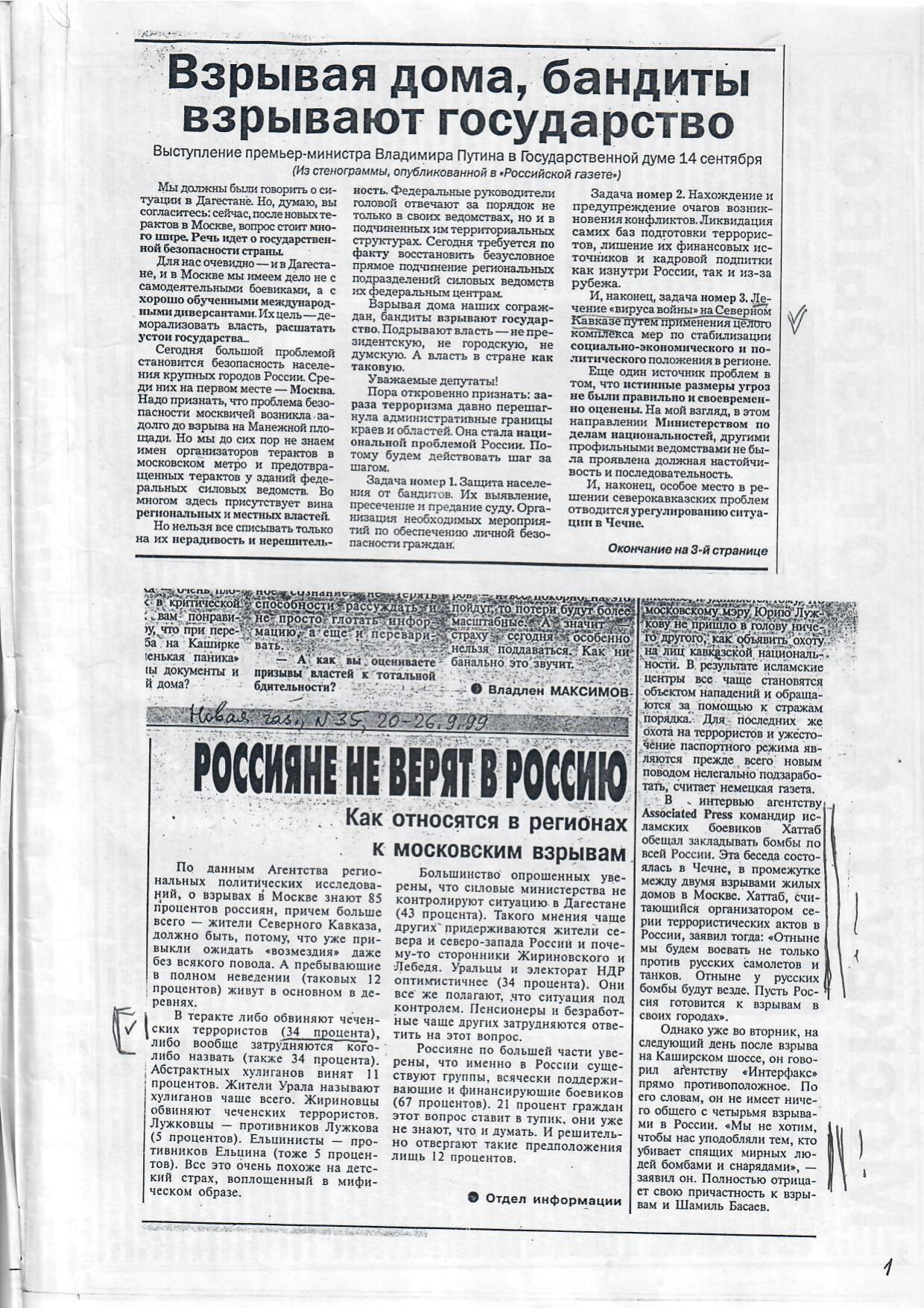
[Рукописная пометка: Новая газ., N 35, 20-26.9.99]
[Фрагмент вверху страницы]
...в критической способности рассуждать и не просто глотать информацию, а еще и переваривать.
— А как вы оцениваете призывы властей к тотальной бдительности?
— Владлен МАКСИМОВ: ...пойдут, то потери будут более масштабные. А значит — страху сегодня особенно нельзя поддаваться. Как ни банально это звучит.
Взрывая дома, бандиты взрывают государство
Выступление премьер-министра Владимира Путина в Государственной думе 14 сентября
(Из стенограммы, опубликованной в «Российской газете»)
Мы должны были говорить о ситуации в Дагестане. Но, думаю, вы согласитесь: сейчас, после новых терактов в Москве, вопрос стоит много шире. Речь идет о государственной безопасности страны.
Для нас очевидно — и в Дагестане, и в Москве мы имеем дело не с самодеятельными боевиками, а с хорошо обученными международными диверсантами. Их цель — деморализовать власть, расшатать устои государства...
Сегодня большой проблемой становится безопасность населения крупных городов России. Среди них на первом месте — Москва. Надо признать, что проблема безопасности москвичей возникла задолго до взрыва на Манежной площади. Но мы до сих пор не знаем имен организаторов терактов в московском метро и предотвращенных терактов у зданий федеральных силовых ведомств. Во многом здесь присутствует вина региональных и местных властей.
Но нельзя все списывать только на их нерадивость и нерешительность. Федеральные руководители головой отвечают за порядок не только в своих ведомствах, но и в подчиненных им территориальных структурах. Сегодня требуется по факту восстановить безусловное прямое подчинение региональных подразделений силовых ведомств их федеральным центрам.
Взрывая дома наших сограждан, бандиты взрывают государство. Подрывают власть — не президентскую, не городскую, не думскую. А власть в стране как таковую.
Уважаемые депутаты!
Пора откровенно признать: зараза терроризма давно перешагнула административные границы краев и областей. Она стала национальной проблемой России. Потому будем действовать шаг за шагом.
Задача номер 1. Защита населения от бандитов. Их выявление, пресечение и предание суду. Организация необходимых мероприятий по обеспечению личной безопасности граждан.
Задача номер 2. Нахождение и предупреждение очагов возникновения конфликтов. Ликвидация самих баз подготовки террористов, лишение их финансовых источников и кадровой подпитки как изнутри России, так и из-за рубежа.
И, наконец, задача номер 3. Лечение «вируса войны» на Северном Кавказе путем применения целого комплекса мер по стабилизации социально-экономического и политического положения в регионе.
Еще один источник проблем в том, что истинные размеры угрозы не были правильно и своевременно оценены. На мой взгляд, в этом направлении Министерством по делам национальностей, другими профильными ведомствами не была проявлена должная настойчивость и последовательность.
И, наконец, особое место в решении северокавказских проблем отводится урегулированию ситуации в Чечне.
Окончание на 3-й странице
РОССИЯНЕ НЕ ВЕРЯТ В РОССИЮ
Как относятся в регионах к московским взрывам
По данным Агентства региональных политических исследований, о взрывах в Москве знают 85 процентов россиян, причем больше всего — жители Северного Кавказа, должно быть, потому, что уже привыкли ожидать «возмездия» даже без всякого повода. А пребывающие в полном неведении (таковых 12 процентов) живут в основном в деревнях.
В теракте либо обвиняют чеченских террористов (34 процента), либо вообще затрудняются кого-либо назвать (также 34 процента). Абстрактных хулиганов винят 11 процентов. Жители Урала называют хулиганов чаще всего. Жириновцы обвиняют чеченских террористов. Лужковцы — противников Лужкова (5 процентов). Ельцинисты — противников Ельцина (тоже 5 процентов). Все это очень похоже на детский страх, воплощенный в мифическом образе.
Большинство опрошенных уверены, что силовые министерства не контролируют ситуацию в Дагестане (43 процента). Такого мнения чаще других придерживаются жители севера и северо-запада России и почему-то сторонники Жириновского и Лебедя. Уральцы и электорат НДР оптимистичнее (34 процента). Они все же полагают, что ситуация под контролем. Пенсионеры и безработные чаще других затрудняются ответить на этот вопрос.
Россияне по большей части уверены, что именно в России существуют группы, всячески поддерживающие и финансирующие боевиков (67 процентов). 21 процент граждан этот вопрос ставит в тупик, они уже не знают, что и думать. И решительно отвергают такие предположения лишь 12 процентов.
Отдел информации
[Боковая колонка]
...московскому мэру Юрию Лужкову не пришло в голову ничего другого, как объявить охоту на лиц кавказской национальности. В результате исламские центры все чаще становятся объектом нападений и обращаются за помощью к стражам порядка. Для последних же охота на террористов и ужесточение паспортного режима являются прежде всего новым поводом нелегально подзаработать, считает немецкая газета.
В интервью агентству Associated Press командир исламских боевиков Хаттаб обещал закладывать бомбы по всей России. Эта беседа состоялась в Чечне, в промежутке между двумя взрывами жилых домов в Москве. Хаттаб, считающийся организатором серии террористических актов в России, заявил тогда: «Отныне мы будем воевать не только против русских самолетов и танков. Отныне у русских бомбы будут везде. Пусть Россия готовится к взрывам в своих городах».
Однако уже во вторник, на следующий день после взрыва на Каширском шоссе, он говорил агентству «Интерфакс» прямо противоположное. По его словам, он не имеет ничего общего с четымя взрывами в России. «Мы не хотим, чтобы нас уподобляли тем, кто убивает спящих мирных людей бомбами и снарядами», — заявил он. Полностью отрицает свою причастность к взрывам и Шамиль Басаев.
Novaya Gaz., No. 35, 20-26.09.99
Excerpts and Commentary
- "...in the critical ability to reason and not just swallow information, but also to digest it."
- "— And how do you evaluate the authorities' calls for total vigilance?"
- Vladlen MAKSIMOV: "...[if they] go, then the losses will be more large-scale. And that means—one must not give in to fear today especially. As cliché as it sounds."
By Blowing Up Houses, Bandits Blow Up the State
Speech by Prime Minister Vladimir Putin in the State Duma on September 14
(From the transcript published in Rossiyskaya Gazeta)
We were supposed to talk about the situation in Dagestan. But I think you will agree: now, after the new terrorist attacks in Moscow, the issue is much broader. We are talking about the state security of the country.
It is obvious to us—both in Dagestan and in Moscow—that we are dealing not with amateur militants, but with well-trained international saboteurs. Their goal is to demoralize the authorities, to shake the foundations of the state...
Today, the safety of the population in Russia's large cities is becoming a major problem. Moscow is in first place among them. It must be admitted that the problem of the safety of Muscovites arose long before the explosion on Manezhnaya Square. But we still do not know the names of the organizers of the terrorist attacks in the Moscow metro and the prevented attacks near the buildings of federal security agencies. To a large extent, the blame lies with regional and local authorities.
But we cannot blame everything only on their negligence and indecision. Federal leaders are personally responsible for order not only in their own departments, but also in the territorial structures subordinate to them. Today, it is required to effectively restore the unconditional direct subordination of regional units of security agencies to their federal centers.
By blowing up the houses of our fellow citizens, the bandits are blowing up the state. They are undermining authority—not presidential, not city, not Duma authority. But authority in the country as such.
Honorable deputies!
It is time to frankly admit: the contagion of terrorism has long since crossed the administrative borders of krais and oblasts. It has become a national problem for Russia. Therefore, we will act step by step.
Action Plan
- Task number 1. Protection of the population from bandits. Their identification, suppression, and bringing to justice. Organization of necessary measures to ensure the personal safety of citizens.
- Task number 2. Finding and preventing hotspots of conflict. Elimination of the terrorist training bases themselves, depriving them of financial sources and personnel replenishment both from within Russia and from abroad.
- Task number 3. Treating the "virus of war" in the North Caucasus by applying a whole range of measures to stabilize the socio-economic and political situation in the region.
Another source of problems is that the true scale of the threat was not correctly and timely assessed. In my view, the Ministry of Nationalities and other relevant agencies did not show proper persistence and consistency in this direction.
And finally, a special place in solving North Caucasian problems is given to the settlement of the situation in Chechnya.
Conclusion on page 3
RUSSIANS DO NOT BELIEVE IN RUSSIA
How the regions view the Moscow bombings
According to data from the Agency for Regional Political Research:
- 85 percent of Russians know about the bombings in Moscow, with the highest awareness among residents of the North Caucasus—likely because they have already grown accustomed to expecting "retribution" even without any reason.
- Those in complete ignorance (12 percent) live mainly in villages.
Blame Allocation in the Terrorist Attack
| Blame Assigned | Percentage | Notes |
|---|---|---|
| Chechen terrorists | 34 percent | |
| Unable to name anyone | 34 percent | |
| Abstract hooligans | 11 percent | Most often cited by residents of the Urals. |
| Chechen terrorists | (Supporters of Zhirinovsky) | |
| Luzhkov's opponents | 5 percent | (Supporters of Luzhkov) |
| Yeltsin's opponents | 5 percent | (Supporters of Yeltsin) |
Note: The distribution of blame is described as being "very similar to a childhood fear embodied in a mythical image."
Perception of Security Control
- 43 percent of respondents are sure that the security ministries do not control the situation in Dagestan.
- This opinion is held more often by residents of the north and northwest of Russia, and, for some reason, by supporters of Zhirinovsky and Lebed.
- Ural residents and the NDR (Our Home is Russia) electorate are more optimistic (34 percent), believing the situation is under control.
- Pensioners and the unemployed find it more difficult than others to answer this question.
Belief in Militant Support
- 67 percent of Russians are convinced that groups exist within Russia that support and finance the militants in every way.
- 21 percent of citizens are stumped by this question; they no longer know what to think.
- Only 12 percent resolutely reject such suggestions.
Information Department
[Sidebar]
- Yuri Luzhkov's declaration of a hunt for "persons of Caucasian nationality" led to Islamic centers increasingly becoming targets of attacks and turning to law enforcement for help.
- A German newspaper reported that for law enforcement, the hunt for terrorists and the tightening of the passport regime are primarily a new excuse to make some illegal money on the side.
- In an interview with the Associated Press, Islamic militant commander Khattab promised to plant bombs all over Russia. This conversation took place in Chechnya, between the two apartment building bombings in Moscow.
- Khattab, considered the organizer of a series of terrorist acts in Russia, stated then: "From now on we will fight not only against Russian planes and tanks. From now on, Russians will have bombs everywhere. Let Russia prepare for explosions in its cities."
- However, on Tuesday, the day after the explosion on Kashirskoye Highway, he told the Interfax agency the exact opposite. According to him, he has nothing to do with the four explosions in Russia. "We do not want to be likened to those who kill sleeping peaceful people with bombs and shells," he stated.
- Shamil Basaev also completely denies his involvement in the bombings.